
Review · BANGKOK
From Bangkok: Railway & Damnoen Saduak Floating Market Tour
Mae Klong Railway Market is the star of this trip: a food market set directly on active railway tracks, where umbrellas and awnings fold away as the train rolls through. Then you trade rails for canals and ride by long-tail boat toward Damnoen Saduak, passing vendors selling fruit, sweets, flowers, and souvenirs.
I like the well-planned half-day timing. You leave Bangkok early, see the markets before the heat becomes too fierce, and usually return by early afternoon. I also like the stop at a local palm sugar home, which adds a useful look at daily work beyond the usual shopping stops. The drawback is the amount of driving, especially the return to Bangkok, and the markets can feel crowded and commercial.
Key points
- Watch the market move for the train: Shopkeepers pull back umbrellas and displays when the train approaches Mae Klong.
- Ride a long-tail boat into the canals: The included boat trip gives you a proper water-level view of Damnoen Saduak.
- Visit two different floating markets: Damnoen Saduak is active and busy, while Lao Tuk Luck offers older-style houses and a quieter look at canal life.
- See palm sugar made locally: The traditional house and coconut plantation stop explains how sugar products are produced.
- Benefit from an early start: Pickup is usually between 6:00 and 7:00 AM, helping you beat some of the crowds and midday heat.
- Expect a guide who helps with the details: Guides including Alex, Mai, Mod, Travis, and Anngee have been praised for photos, clear explanations, and keeping groups together.
Why the railway market is worth the early start
The tour begins with hotel pickup in Bangkok, usually between 6:00 and 7:00 AM. The exact time depends on your hotel and the pickup route, so you should be ready in the lobby 15 minutes early. The drive toward Ratchaburi Province takes about an hour and a half, covering roughly 100 kilometers southwest of Bangkok.
That early departure matters. Mae Klong Railway Market is popular, and the narrow market lanes become harder to move through once crowds build. An early visit gives you a better chance of finding a safe viewing place near the tracks without spending the whole stop trying to see over people.
Mae Klong is also called Talad Rom Hup, which means the umbrella-pulldown market. The name tells you exactly what makes the place unusual. Produce, seafood, snacks, and other goods are displayed right beside the railway. When a train approaches, vendors pull back awnings and move merchandise away from the rails. Once the train has passed, the market returns to normal with surprising speed.
You get about an hour here, including a guided walk. That is enough time to look through the stalls, take photos, and watch the railway routine without turning the first stop into a long shopping session. Guides such as Travis and Alex have helped groups find a good place for the train and take photos at the right moment. That assistance is useful because the best view depends on where you are standing when the train arrives.
The train may pass through more than once during your visit, depending on the schedule. One experience included two passes and a chance to photograph the train close to the market. Exact train movements can vary, so treat that as a possibility rather than a guarantee.
The market is not just a photo set. You can look at local food, browse stalls, and pick up a drink or snack. Still, it is worth keeping your expectations clear. This is an active market with a railway running through it, not a preserved museum. The setting is fascinating, but the stop can feel hectic, especially when the train and shoppers compete for the same narrow space.
More Floating Market Tours in Bangkok
- Bangkok: Damnoen Saduak Market and Maeklong Railway Market
★ 4.5 · 26,723 reviews - The Old Siam: Damnoen Saduak and Maeklong Railway Market
★ 4.5 · 10,992 reviews - Bangkok: Train Market & Floating Market with Boat Ride
★ 4.7 · 9,547 reviews
Trading rails for canals at Damnoen Saduak
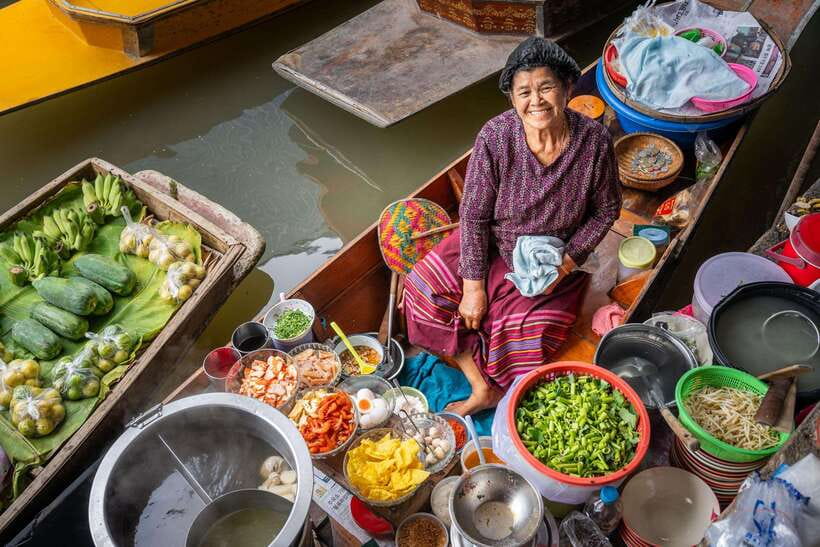
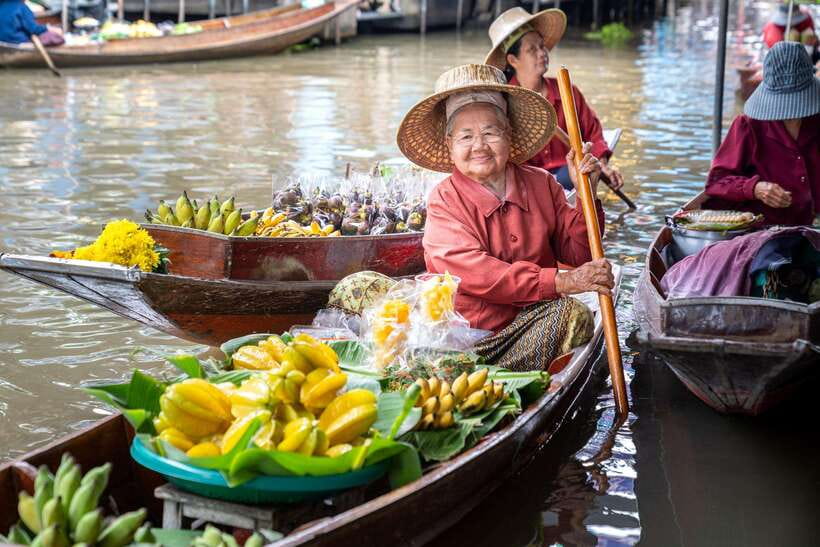
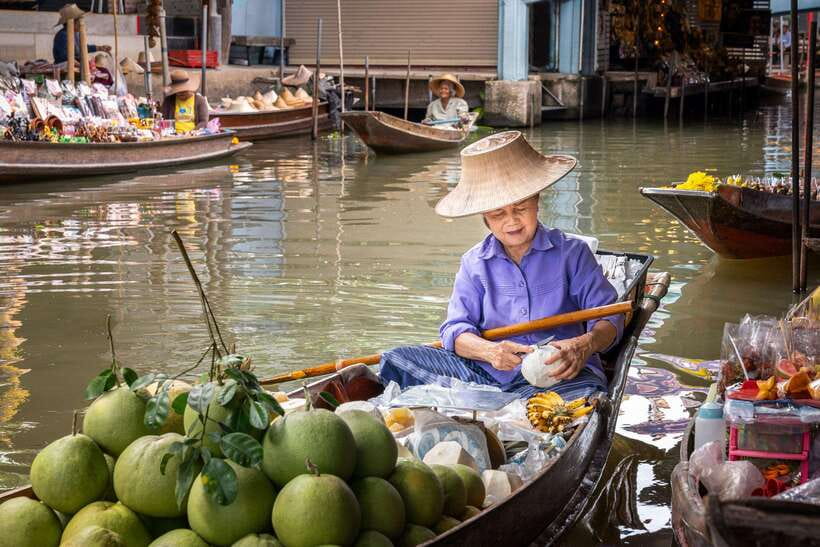
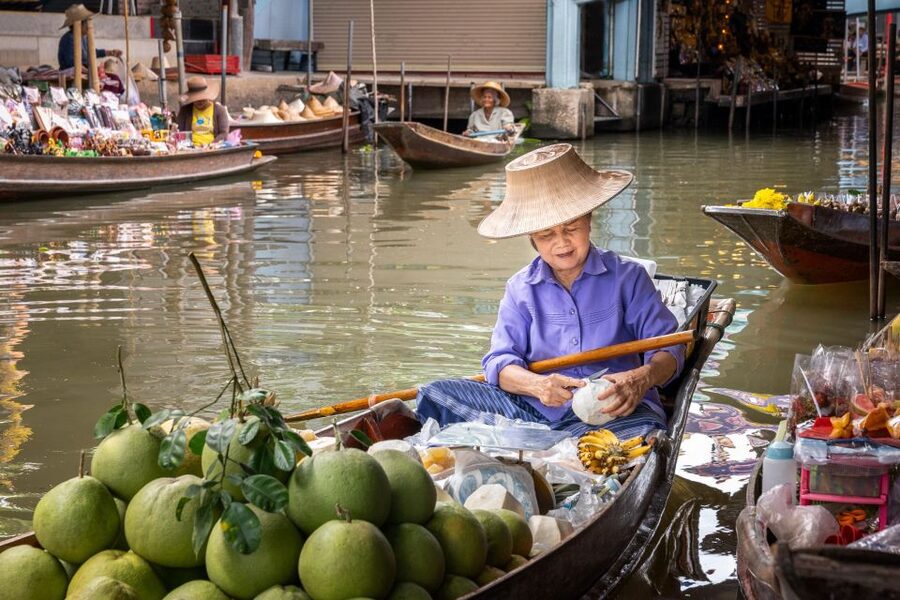
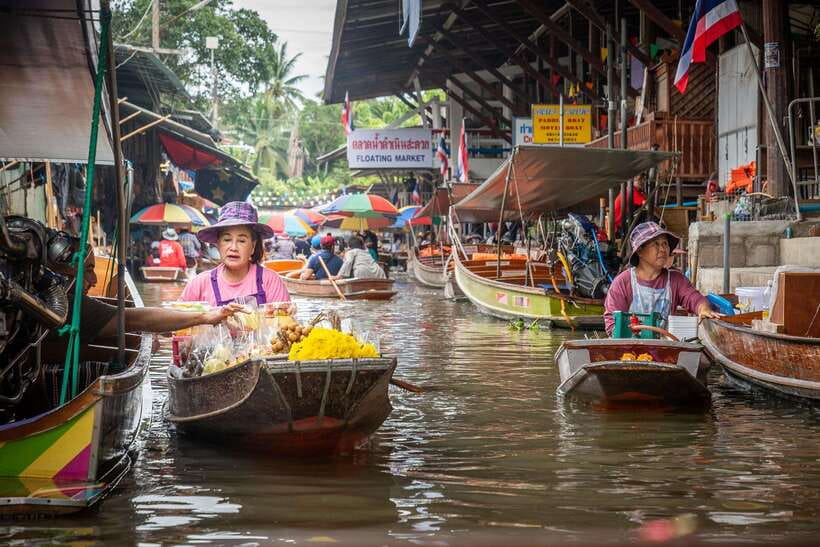
After Mae Klong, the van continues for about 30 minutes to Damnoen Saduak Floating Market. Here, the included long-tail boat ride changes the pace completely. Instead of seeing the market only from the edge, you travel along the waterways, passing boats loaded with produce, sweets, flowers, clothing, and souvenirs.
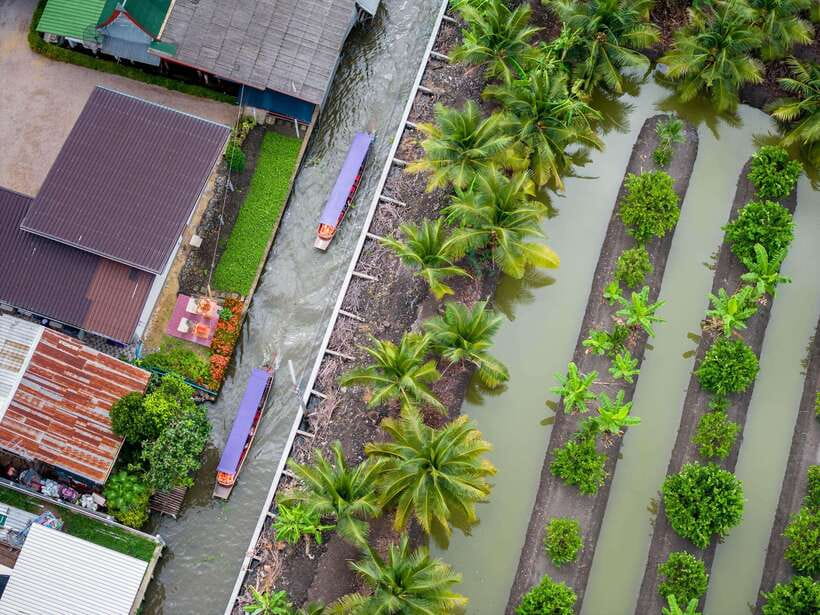
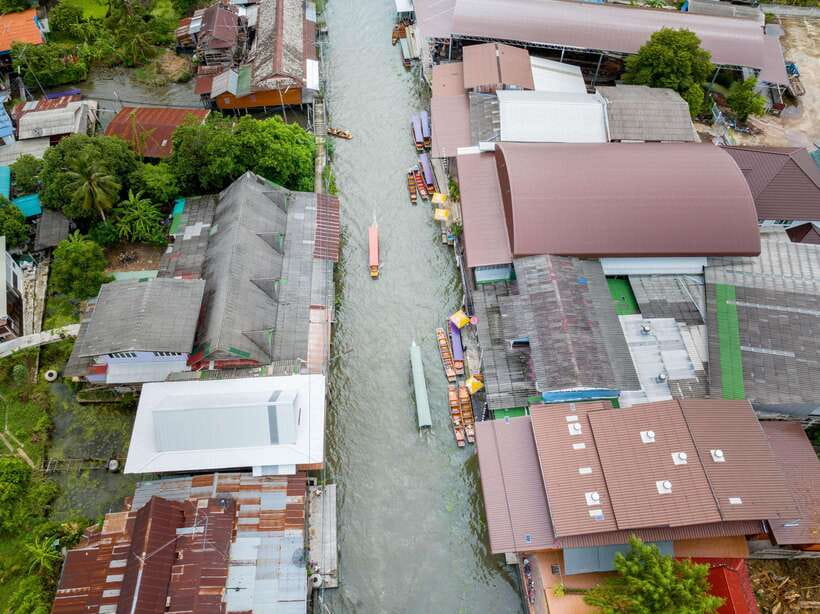
The canals reflect an older way of moving goods. Before roads became the main way to get around, these waterways were important transport routes. Your guide explains that background while you pass traditional boats and canal-side homes. The boat is not simply a transfer to the market. It is the part that lets you understand why a floating market developed here in the first place.
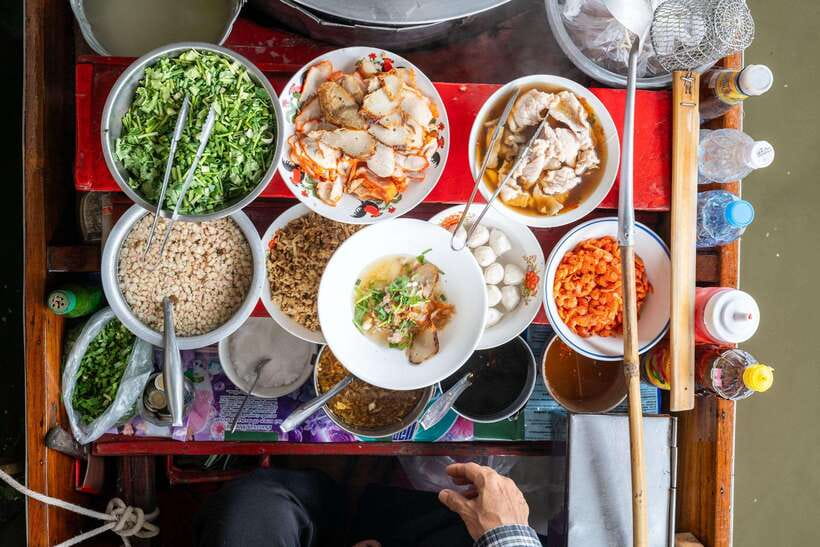
You have about an hour at Damnoen Saduak, including the guided boat ride and time for local snacks. You can walk among the stalls afterward, look for fresh fruit, and shop for small gifts. Coconut products, handmade sweets, clothing, and other food items are common sights.
A paddle boat is available at your own expense. This is separate from the included long-tail boat ride. If you want to move more slowly through the market or spend more time close to the vendors, the paddle boat can make sense. If you are satisfied with the included boat trip, you can skip the extra charge and use your time to walk around.
The market can be crowded. One useful advantage of a guide is that you do not have to work out the route alone or worry about losing the group in a busy area. The guide can also point out food and explain what you are seeing. Several guides have offered tastings of local products, while others have helped with bargaining and photos.
The shopping side deserves a measured view. You will see genuine local produce and food prepared in a traditional setting, but Damnoen Saduak is also a well-known sightseeing stop. Some stalls are aimed squarely at visitors. I would enjoy it for the color, movement, food, and canal ride rather than expect a completely untouched market.
Lao Tuk Luck gives the canals more context
The next stop is Lao Tuk Luck Market, also called Old Damnoen Saduak Market. You spend about 30 minutes here, with a guided walk and sightseeing.
This smaller stop helps balance the busier main market. You see traditional-style houses and traders selling fruit, vegetables, and other goods in an older setting. The emphasis is less on racing through a large shopping area and more on seeing how homes, boats, and commerce fit together along the canals.
Thirty minutes is not long, but it works well within a half-day tour. You can look around, hear the guide explain the older market style, and take photos without adding another long block of walking in the heat. If you prefer extended shopping, the short visit may feel limiting. If you want variety without spending all morning at one market, it is a useful addition.
This is one reason the full route works better than a simple railway market and floating market transfer. You see the modern tourist-facing side of Damnoen Saduak, then get a brief look at an older canal market with a different feel.
A palm sugar stop at a traditional Thai home
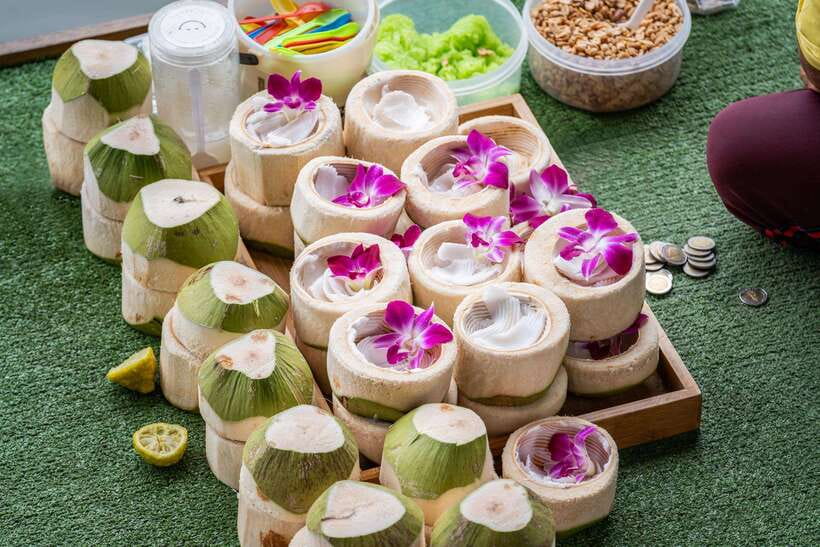
After the floating markets, the tour stops at Baan Tao Thai Derm for about 30 minutes. The visit focuses on a traditional home and local production of sugar palm products connected with coconut plantations.
This stop gives the day a human scale. At the markets, you see finished foods and goods for sale. Here, you get an explanation of how local producers make sugar products and other coconut-related items. The demonstration makes more sense of the sweets and ingredients you may have already seen at the stalls.
The setting has also been described as a family home and shop, which makes it more personal than a large commercial factory visit. You may see coconut products such as sugar, oil, or milk, depending on what is being demonstrated that day. There may be an opportunity to buy something, but the main value is learning how the products are made.
This is the stop that divides opinion most clearly. I like it because it adds local work and household tradition to a route otherwise centered on markets. If your priority is shopping time, you may prefer another 30 minutes at the floating market. One person specifically would have preferred more market time instead of the coconut stop. The guide can sometimes adjust the pace, especially on a private tour, but the listed route includes this visit.
More Floating Market Tours in Thailand
- Half-Day Railway Market and Floating Market Tour in Thailand
★ 4.5 · 3,924 reviews - Bangkok: Damnoen Saduak, Train Market & Mahanakhon Day Trip
★ 4.7 · 2,162 reviews - From Bangkok: Damnoen Saduak Floating Market Guided Tour
★ 4.4 · 2,020 reviews - Damnoen Saduak Floating Market and Maeklong Railway Market Tour
★ 4.5 · 1,588 reviews
What the van ride means for your day
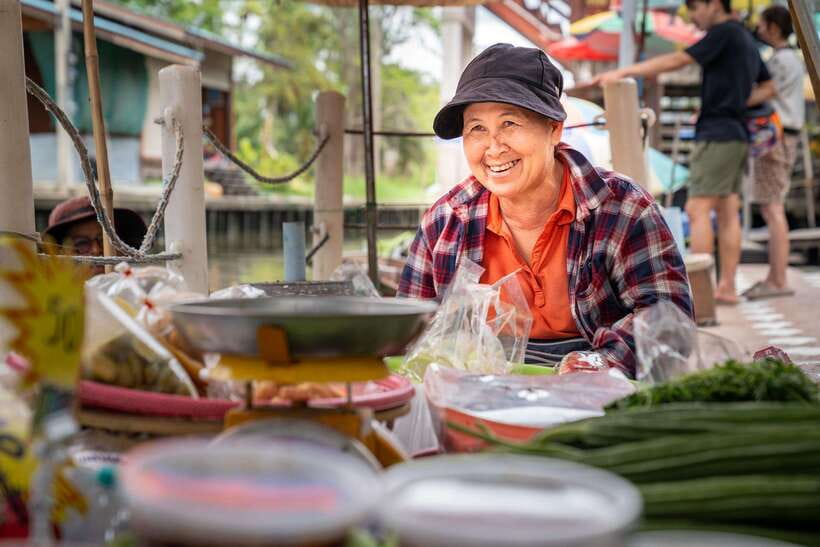
The tour uses an air-conditioned van, with hotel pickup and drop-off in Bangkok. The drive to the first market is about 1.5 hours, and the return journey can take around 100 minutes before hotel drop-offs. Total time is about six to seven hours, usually returning between 1:00 and 2:00 PM.
That timing makes this a practical choice if you want to keep your afternoon free. You may have time for lunch, a temple, a museum, or a rest at your hotel after returning to Bangkok. The tradeoff is clear: a large part of the day is spent in the van. One person found the trip back too long, and that is a fair concern, particularly if traffic slows the final leg.
The air conditioning matters in Thailand’s heat. You should still wear light, comfortable clothes and bring water, though drinking water and snacks are included. Comfortable shoes are useful at the railway market, where you will walk beside tracks and through narrow market lanes. Cash is worth carrying for food, souvenirs, and the optional paddle boat.
Pickup coverage includes hotels in Bangkok city outskirts, including areas such as Chatuchak, Lard Pao, Bang Khen, Don Mueang, and near Suvarnabhumi. The operator confirms the exact pickup time by email or by contacting you by 10:00 PM the night before, so check your messages and provide your full name, hotel name, and hotel address when booking.
The guide can make or break a crowded market day
The route is easy to follow on paper, but the guide affects how relaxed the day feels. You are moving through tight market lanes, boarding a boat, watching a train, and keeping to a schedule. A guide who manages those transitions well saves time and stress.
Alex has been especially praised for finding good train-viewing spots, taking photos, answering cultural questions, and helping families. Mai has provided snacks, photos, and explanations at the coconut production stop. Mod has been described as lively and welcoming, while Travis has helped groups with photography, local recommendations, and extra care when someone felt unwell.
Other guides, including Angee, TK, Apple, Chris, Kathy, and Peak, have also been praised for clear English, patience, and attention to the whole group. That does not mean you can select a particular guide when booking, but it does show the kind of support the tour aims to provide.
Photo help is a small but real benefit. At Mae Klong, it is hard to watch the train and frame a picture at the same time. A guide can tell you where to stand and take photos for you. Some guides have also sent photos afterward, though you should not treat that as a guaranteed inclusion.
Private and small-group options are available. A small group is a good middle ground for most people: you get the structure of shared transport but still have a more personal chance to ask questions. A private booking makes more sense for families, groups of friends, or anyone who wants more control over time at the markets.
Is $43 good value for this route?
At $43 per person, the price covers a lot for a seven-hour outing: hotel pickup and drop-off, an air-conditioned van, an English-speaking guide, the long-tail boat ride, snacks, drinking water, and accidental insurance. You are also paying for the convenience of linking two destinations that are awkward to combine independently from Bangkok.
The strongest value comes from the transport and organization. You do not need to arrange a van, find the railway market, work out the canal boat, or manage the return trip. The guide also adds practical help at the train and floating market, where timing and crowd control matter.
The price does not cover a paddle boat, extra food, or additional drinks. Keep cash for those costs. The markets themselves also invite purchases, so your final spending can rise if you buy snacks, clothing, souvenirs, or coconut products.
I would call the price fair for a first visit, especially if you have limited time in Bangkok. It is less compelling if you already have private transport or want several hours for unhurried shopping. The experience is built around variety and ease, not a slow, independent market day.
Who should book this half-day trip?
I would recommend it if you want to see both famous markets without handling the transport yourself. It suits first-time visitors, families, solo visitors who want a guide, and anyone interested in food, canals, photography, and everyday production.
Families can benefit from the short stops and air-conditioned transport. A guide can also help children stay engaged with the train, boat, snacks, and coconut products. The route has been enjoyed by families with children as young as eight, though the heat and crowds still require patience.
You should think twice if you dislike early mornings, long van rides, crowded markets, or shopping-focused stops. Pregnant women, wheelchair users, and people over 70 are listed as unsuitable for this activity. The railway market and boat portions may be uncomfortable if walking, boarding, or standing for short periods is difficult.
Free cancellation is available up to 24 hours before departure, and you can reserve now and pay later. That flexibility is useful when Bangkok plans are still shifting, but you should still confirm the pickup details the evening before.
Should you book the Railway and Floating Market Tour?
Book it if you want a tidy, well-supported route that combines the train market, a canal ride, two floating-market settings, and a local palm sugar stop before early afternoon. The train passing through Mae Klong is the strongest single moment, while the boat ride and palm sugar visit give the day more substance than a quick photo stop.
Skip it if you want long, quiet hours to shop or if the return drive sounds tiring. In that case, a private arrangement may suit you better, particularly if you want to change the balance between market time and the coconut stop.
For most visitors with one free morning, I think the $43 price is sensible. Go early, carry cash, wear comfortable shoes, and let the guide handle the tricky parts around the train and canals.
FAQ
How long does the tour last?
The tour lasts approximately six to seven hours, including hotel pickup and drop-off. Depending on your position in the drop-off route, you may return to your hotel around 1:00 PM, 1:30 PM, or as late as 2:00 PM.
What time is hotel pickup?
Pickup is usually between 6:00 and 7:00 AM. The tour operator confirms the exact time by email or by contacting you by 10:00 PM the evening before. You should wait in the hotel lobby 15 minutes before pickup.
Is transportation included?
Yes. The tour includes hotel pickup and drop-off in Bangkok and transport by air-conditioned van.
Is the boat ride included?
The long-tail boat ride to Damnoen Saduak is included. A separate paddle boat rental is available at your own expense.
What is not included in the price?
Extra food and drinks are not included. You also pay separately if you choose to rent a paddle boat.
Is the tour suitable for children?
The provided information does not set a minimum age. Families have taken the tour with children, including an eight-year-old, but you should consider the early start, heat, crowds, walking, and boat boarding.
Is the tour suitable for everyone?
No. It is listed as unsuitable for pregnant women, wheelchair users, and people over 70 years old. Comfortable shoes, comfortable clothing, a camera, and cash are recommended.
More Shopping Tours in Bangkok
- Bangkok: Railway and Floating Market Tour with Dragon Temple
★ 4.6 · 1,225 reviews - Bangkok: Maliwan Thai Cooking Class with Market Tour
★ 4.9 · 1,133 reviews - Bangkok: Floating Market and Train Market Experience
★ 5.0 · 1,074 reviews - Floating & Railway Market and Coconut Farm Tour [Optional Luxury]
★ 5.0 · 835 reviews
More Markets in Bangkok
- Bangkok: City Highlights Temple and Market Walking Tour
★ 4.5 · 3,990 reviews - Bangkok: Hands-on Thai Cooking Class and Market Tour
★ 4.9 · 1,614 reviews - Day Trip to Bangkok Floating Market & Maeklong Railway
★ 5.0 · 1,528 reviews - From Bangkok: Floating Market and Ayutthaya Guided Day Tour
★ 4.6 · 1,398 reviews
Just added around Bangkok
- Bangkok Udomsuk Thai Cooking Class with local market tour★ 5.0 · 5 reviews
- Morning Buddhist Almsgiving, Grand Palace and Flower Market Tour in Bangkok★ 3.5 · 9 reviews
- Private 4 days : Bangkok, Floating market and Ayutthaya★ 5.0 · 2 reviews
- Floating & Railway Markets and Erawan Waterfall [Optional Luxury]★ 5.0 · 43 reviews
- Discover Ayutthaya at Sunset: Historic Temples & River Cruise★ 4.5 · 29 reviews
- Floating Market & Railway Market near Bangkok★ 4.0 · 5 reviews
- Silom Thai Cooking School with Fresh Market Tour★ 5.0 · 73 reviews
- Ayutthaya Floating Market Admission Ticket with Transfer★ 5.0 · 2 reviews
Floating Market Tours, compared.
Damnoen Saduak Market and Maeklong Railway Market
Read our review →
The Old Siam: Damnoen Saduak and Maeklong Railway Market
Read our review →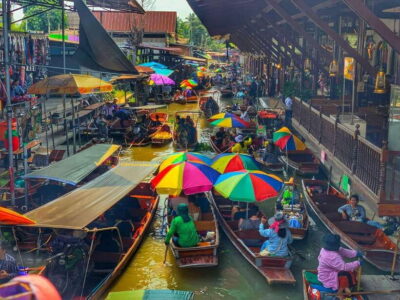
Train Market & Floating Market with Boat Ride
Read our review →
Ayutthaya & Ayothaya Floating Market Day Trip
Read our review →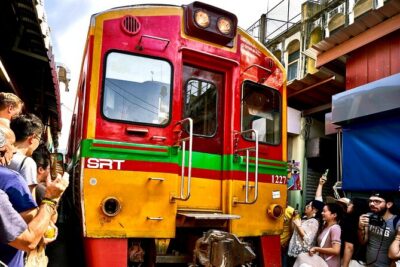
Half-Day Railway Market and Floating Market Tour in Thailand
Read our review →
Cooking Class Hoi An:Local Market, Basket Boat, Fishing & Cooking
Read our review →
Market Tour, Basket Boat Ride and Cooking Class
Read our review →Browse the lists this tour appears in