
Review · BANGKOK
Flower Market & Floral Art: Multilingual Private Tour [EN/others]
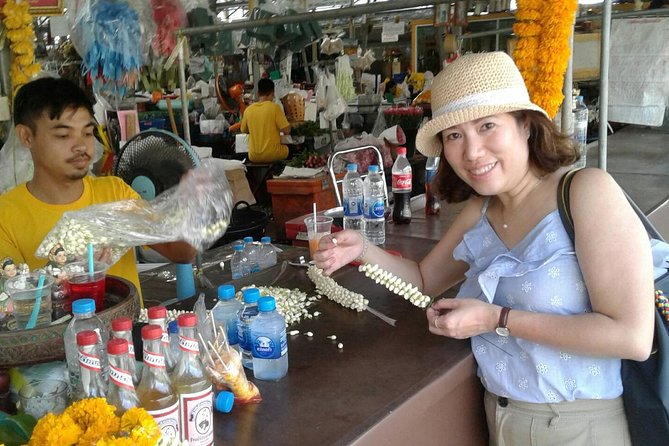
Bangkok’s flower market is more than a place to snap colorful photos. Here, you can work with local sellers and artisans, folding cone-shaped and ball-shaped lotuses before learning to make a Thai jasmine garland. I like the way the tour turns a market visit into something you do with your hands, and I like the short ferry ride across the river to Kalayanamitr Temple and the Kudi Chin neighborhood.
The private format lets your guide adjust the pace. Guides such as Nina and Nine have been praised for being warm and flexible, including adding cold drinks or an ice cream stop for families. The main caution is that the tour depends on the guide delivering both workshops as described, so confirm the floral activities at the start, especially if flower craft is your main reason for booking.
Key things to know
![Flower Market & Floral Art: Multilingual Private Tour [EN/others] - Key things to know](https://1.marketescapes.com/wp-content/uploads/flower-market-floral-art-multilingual-private-tour-en-others-1.jpg)
- Two hands-on flower activities: Fold Bua Luang and Bua Chut lotuses at the market, then make a Thai garland with local artisans.
- A useful river crossing: A ferry connects the flower market area with Kalayanamitr Temple and adds a pleasant change from Bangkok’s roads.
- Quiet cultural stops: The Guanyin Shrine, Santa Cruz Church, and Baan Kudi Chin Museum show Bangkok beyond its headline sights.
- Private attention: Only your group takes part, with a choice of morning or afternoon departure and a multilingual guide option.
- Good family potential: Children as young as 9 and 11 enjoyed the hands-on format, though the walking and heat still require stamina.
- A fair but not cheap price: At $95.17 per person, the value comes from the private guide, workshops, transport, and museum admission rather than from sightseeing alone.
Why this flower tour feels different from a standard Bangkok outing
Many Bangkok tours rush from one famous temple to another. This one uses flowers as the thread connecting the city’s daily life, religious customs, and local communities.
You begin at Pak Khlong Talat, Bangkok’s original and largest flower market. Florists come here to buy fresh flowers, so the market has a working purpose beyond tourism. You may see piles of cut flowers, garland materials, and sellers preparing orders, with the strongest market activity often connected to the early morning trade.
The tour then takes you from looking to doing. You fold lotus flowers and later work with Thai artisans on garland making. That change matters. Instead of simply hearing that flowers are used in Buddhist offerings, you make part of the offering yourself.
I also like the route’s mix of neighborhoods and traditions. The trip includes a Thai temple, a Chinese shrine, a Portuguese Catholic church, and a museum focused on the Siam-Portuguese community. It gives you several views of Bangkok’s religious life without trying to turn the afternoon into a checklist of major landmarks.
More Flower and Flea Market Tours in Bangkok
- Bangkok: Night Bike Tour with Temples & Flower Market Visit
★ 4.8 · 751 reviews - Bangkok: Night Bike Tour with Temples & Flower Market Visit
★ 5.0 · 223 reviews - Bangkok Wat Pho and Flower Market Historical Walking Tour
★ 5.0 · 28 reviews
Starting at Pak Khlong Talat Flower Market
![Flower Market & Floral Art: Multilingual Private Tour [EN/others] - Starting at Pak Khlong Talat Flower Market](https://1.marketescapes.com/wp-content/uploads/flower-market-floral-art-multilingual-private-tour-en-others-2.jpg)
The listed meeting point is Rajini School at 444 Thanon Maha Rat, in Bangkok’s Phra Nakhon district. From there, you walk toward the river and the flower market area. The exact flow can vary with the selected departure and local conditions, but plan on being ready for outdoor walking from the beginning.
The first market visit lasts about 30 minutes and admission is included. That is enough time to see the market’s scale and ask your guide about the flowers used in Thai offerings, ceremonies, and garlands.
Do not expect a polished indoor attraction. This is a working market, and conditions may be crowded, warm, wet, or strongly scented. Jasmine can have a powerful fragrance, which one guest specifically remembered. For many people, that is part of the appeal. If you prefer quiet, cool rooms and carefully arranged displays, this stop may feel rough around the edges.
The market is best appreciated with your guide’s local explanation. On your own, you might see heaps of flowers but miss the practical question of who buys them and how they fit into Bangkok’s religious and social customs.
Folding Bua Luang and Bua Chut lotuses
After seeing the market, you take part in a short lotus handicraft session with a local lotus seller. The workshop lasts about 20 minutes and covers two forms:
- Bua Luang, a cone-shaped lotus
- Bua Chut, a ball-shaped lotus
The activity is simple in materials but meaningful in context. You are not making a souvenir for a shop shelf. You bring the folded lotuses to a Buddha image as an offering, which gives the craft a clear purpose.
This is one of the best parts for families. Children can take part without needing specialist skills, and the task gives them something concrete to focus on during a temple-centered morning or afternoon. It also slows the pace after the market’s visual overload.
The short session has limits. Twenty minutes is enough for an introduction, not a full class in Thai floral design. If you want a long craft lesson with several finished pieces, this tour may feel brief. The later one-hour garland workshop is the more substantial craft session.
Crossing the river to Kalayanamitr Temple
![Flower Market & Floral Art: Multilingual Private Tour [EN/others] - Crossing the river to Kalayanamitr Temple](https://1.marketescapes.com/wp-content/uploads/flower-market-floral-art-multilingual-private-tour-en-others-4.jpg)
The route includes a ferry ride to Wat Kalayanamitr Varamahavihara. The crossing provides a welcome breeze and a break from Bangkok traffic. The itinerary includes a short stop at the pier to feed fish, a Thai merit-making practice associated with good fortune and abundance.
This is a small moment, but it gives your guide room to explain how everyday acts at temples can carry religious meaning. You are not simply passing through a sacred site for a photograph. You get a glimpse of how local people use the river and temple grounds as part of ordinary life.
The fish-feeding stop lasts about 10 minutes. It is not a major attraction, so keep your expectations modest. Its value lies in the pause, the river setting, and the cultural explanation.
More Private Market Tours in Bangkok
- Private Excursion to Maeklong Railway and Floating Markets
★ 5.0 · 850 reviews - Floating and Railway Market (Optional Waterfall): Private Tour
★ 5.0 · 827 reviews - Private Excursion to Floating Market and Ayutthaya World Heritage
★ 5.0 · 515 reviews - Private Tour to Railway Market and Damnoen Saduak Floating Market
★ 5.0 · 200 reviews
Kalayanamitr Temple and the Sam Por Kong Buddha
![Flower Market & Floral Art: Multilingual Private Tour [EN/others] - Kalayanamitr Temple and the Sam Por Kong Buddha](https://1.marketescapes.com/wp-content/uploads/flower-market-floral-art-multilingual-private-tour-en-others-5.jpg)
At Kalayanamitr Temple, you have about 20 minutes to enter the temple and pay respect to Sam Por Kong, described as one of Bangkok’s largest golden Buddha images.
The temple brings together Thai and Chinese Buddhist influences. That blend fits the wider route, which keeps showing how Bangkok’s communities have shaped one another over time. Your guide can help you notice the difference between simply entering a temple and understanding why the site matters to worshippers.
Temple visits require respectful behavior. Dress should be suitable for a religious site, and you should be prepared to remove shoes if required in the temple area. The stop is short, so this is more of a focused visit than a long architectural study.
The one-hour Thai garland workshop
![Flower Market & Floral Art: Multilingual Private Tour [EN/others] - The one-hour Thai garland workshop](https://1.marketescapes.com/wp-content/uploads/flower-market-floral-art-multilingual-private-tour-en-others-6.jpg)
The main floral activity takes place near Kalayanamitr Temple and lasts about an hour. Thai artisans from the Kudi Khow community lead the work, and the tour supports a local social enterprise.
This is the tour’s strongest reason to book. You have time to learn the process rather than simply watching someone make a garland. The flower work connects to offerings made at Buddhist temples, so the craft has cultural meaning as well as visual appeal.
The workshop also puts money and attention into a local community. That does not turn the activity into a formal social project visit, but it gives the stop a practical local connection. You are learning from people who make these floral pieces, not from a generic demonstration designed only for tourists.
The experience can vary with the guide and artisans available on the day. One past participant felt the floral art portion was much smaller than expected when the guide was leading the tour for the first time. That is the clearest warning attached to this experience. If the garland workshop is your priority, tell the guide early and make sure the planned hour is included.
Past guests also praised guides Nina and Nine for creating a calm, friendly mood. One family appreciated that Nina adjusted the outing with extra time for cold drinks and ice cream. That sort of flexibility is a real benefit of a private tour, though it depends on timing and your guide.
Guanyin Shrine and Bangkok’s Chinese traditions
![Flower Market & Floral Art: Multilingual Private Tour [EN/others] - Guanyin Shrine and Bangkok’s Chinese traditions](https://1.marketescapes.com/wp-content/uploads/flower-market-floral-art-multilingual-private-tour-en-others-7.jpg)
The itinerary then moves to San Chao Kian An Keng, a Guanyin Shrine. The listed visit is about 10 minutes, with the schedule showing an 11:40 a.m. arrival for one version of the route.
The shrine dates to the reign of King Taksin, around 230 years ago. Its Guanyin statue is described as different from the figures found in many other shrines, giving your guide a specific detail to point out during this quick stop.
Because the visit is short, do not expect a full temple tour. Think of it as a compact introduction to Bangkok’s Chinese religious traditions before the route shifts again to the Portuguese Catholic community.
Santa Cruz Church and the Kudi Chin quarter
![Flower Market & Floral Art: Multilingual Private Tour [EN/others] - Santa Cruz Church and the Kudi Chin quarter](https://1.marketescapes.com/wp-content/uploads/flower-market-floral-art-multilingual-private-tour-en-others-8.jpg)
From the shrine, you walk to Santa Cruz Church, also called Kudi Chin. The stop lasts about 10 minutes and introduces the Portuguese presence in Thailand.
The church’s story begins when King Taksin granted land to Portuguese people after the fall of Ayutthaya. That history helps explain why a Catholic church exists beside Buddhist and Chinese religious sites along this river route.
The walk through the neighborhood is one of the tour’s quieter pleasures. You get a look at a community shaped by different cultures, rather than another major attraction built for mass sightseeing. This part is especially useful if you want Bangkok to feel like a lived-in city, not just a collection of temples and markets.
The walk is also where the physical demands become clearer. The tour is not recommended for people with walking difficulty. Heat, uneven surfaces, and several short stops can add up, even though no single segment is especially long.
Baan Kudi Chin Museum and the local snack
The final major stop is Baan Kudi Chin Museum, a local learning center about the area’s history, religion, and food traditions. Admission is included, and the visit lasts about 20 minutes.
The museum focuses on the Siam-Portuguese lineage that still lives in the neighborhood. This gives the earlier church stop more context and shows how cultural identity can continue through food, faith, and family life.
You also have the chance to try a Kudi Chin snack. The tasting is a small but welcome finish because food often explains a community better than a plaque does. The museum visit is compact, so you should not expect a large collection or a long museum lecture. Its strength is the connection between the exhibits and the streets you have just walked through.
The tour ends back at the listed meeting point. The package also includes a private air-conditioned vehicle for hotel transfer, so check the exact pickup arrangement when booking, especially since the published start and end point is Rajini School.
Price, private format, and what you receive
At $95.17 per person, this is not a budget market walk. The price makes more sense if you use the full package: a private licensed guide or interpreter, a flower-market lotus activity, the one-hour garland workshop, museum admission, travel accident insurance, and private air-conditioned vehicle service for hotel transfer.
You also pay for time and attention. On a shared tour, a short craft lesson can become a rigid demonstration. With a private group, you can ask questions, slow down, or request a brief break when the heat becomes tiring.
Lunch is not included. You order and pay for that yourself, so allow for the possibility that the four-hour schedule may not include a full meal. Free cancellation is available up to 24 hours before the start time, which gives you some flexibility if your Bangkok plans change.
The tour is offered in English, Spanish, Italian, German, French, and Chinese, depending on the option selected. Check the language carefully before paying, since the quality of the experience depends heavily on clear explanations during the workshops and temple visits.
Who should book this experience
I would choose this tour if you want:
- A private Bangkok outing with a strong local focus
- Hands-on craft work instead of only sightseeing
- A gentle introduction to Buddhist offerings and Thai floral customs
- A river crossing and several small cultural stops
- A family activity that children can join
- A route outside the city’s most famous tourist circuit
I would think twice if you want a long, formal flower-arranging class, a leisurely temple study, or a tour with very little walking. The market can be pungent and crowded, the route is outdoors, and several stops are brief.
The experience is also best for someone who enjoys variety. In four hours, you shift from a wholesale flower market to lotus folding, ferry travel, temple worship, garland making, a Chinese shrine, a Portuguese church, and a neighborhood museum. That is a lot of ground in a short time.
Should you book the Flower Market and Floral Art tour?
Book it if you want Bangkok with your hands busy and your eyes open. The strongest parts are the working flower market, the one-hour garland workshop, the ferry ride, and the Kudi Chin neighborhood. The private format adds real value for families and for anyone who likes asking questions at their own pace.
Before booking, confirm the language, pickup details, and the amount of time reserved for both floral activities. If the workshop is properly delivered, $95.17 is a reasonable price for a private half-day with transport, museum entry, and local instruction. If you mainly want a large flower market and a few quick temple photos, you can likely find a cheaper outing. If you want to understand how flowers, faith, and Bangkok’s mixed communities fit together, this is the better choice.
FAQ
How long does the Flower Market and Floral Art tour last?
The tour lasts approximately four hours.
Where does the tour start?
The listed meeting point is Rajini School at 444 Thanon Maha Rat in Bangkok’s Phra Nakhon district.
Where does the tour finish?
The activity ends back at the meeting point.
Is the tour private?
Yes. Only your group participates in the private activity.
Which languages are available?
The guide or interpreter can be provided in English, Spanish, Italian, German, French, or Chinese, depending on the option purchased.
Are the flower workshops included?
Yes. The tour includes a Thai lotus-folding workshop with a local vendor and a Thai garland workshop with local artisans.
Is Baan Kudi Chin Museum admission included?
Yes, museum admission is included. The museum is closed on Mondays.
Is lunch included?
No. Lunch is self-ordered and paid for separately.
Can I cancel for a full refund?
Yes. You can cancel at least 24 hours before the experience start time for a full refund. Changes or cancellations made less than 24 hours before the start time are not accepted or refunded.
More Markets in Bangkok
- Bangkok: Damnoen Saduak Market and Maeklong Railway Market
★ 4.5 · 26,723 reviews - The Old Siam: Damnoen Saduak and Maeklong Railway Market
★ 4.5 · 10,992 reviews - Bangkok: Train Market & Floating Market with Boat Ride
★ 4.7 · 9,547 reviews - Bangkok: City Highlights Temple and Market Walking Tour
★ 4.5 · 3,990 reviews
More Private Market Tours in Thailand
- Private Tour: Floating Markets of Damnoen Saduak Cruise Day Trip from Bangkok
★ 3.5 · 199 reviews - Floating Market & Train Market Private Tour(Premium Service)
★ 5.0 · 112 reviews - Maeklong Railway & Floating Market Tour (Private & All-Inclusive)
★ 5.0 · 108 reviews - Private Tour to Railway Market Floating Market and Ayutthaya
★ 5.0 · 104 reviews
Just added around Bangkok
- Bangkok Udomsuk Thai Cooking Class with local market tour★ 5.0 · 5 reviews
- Morning Buddhist Almsgiving, Grand Palace and Flower Market Tour in Bangkok★ 3.5 · 9 reviews
- Private 4 days : Bangkok, Floating market and Ayutthaya★ 5.0 · 2 reviews
- Floating & Railway Markets and Erawan Waterfall [Optional Luxury]★ 5.0 · 43 reviews
- Floating Market & Railway Market near Bangkok★ 4.0 · 5 reviews
- Discover Ayutthaya at Sunset: Historic Temples & River Cruise★ 4.5 · 29 reviews
- Silom Thai Cooking School with Fresh Market Tour★ 5.0 · 73 reviews
- Ayutthaya Floating Market Admission Ticket with Transfer★ 5.0 · 2 reviews
Flower & Flea Market Tours, compared.

Night Bike Tour with Temples & Flower Market Visit
Read our review →Night Bike Tour with Temples & Flower Market Visit
Read our review →

Jaipur Tour by Tuk-Tuk or Car with Flower Market
Read our review →
Half-Day Guided Sightseeing Tour with Flower Market
Read our review →
Half or Full Day Sightseeing Tour with Flower Market
Read our review →

Browse the lists this tour appears in