
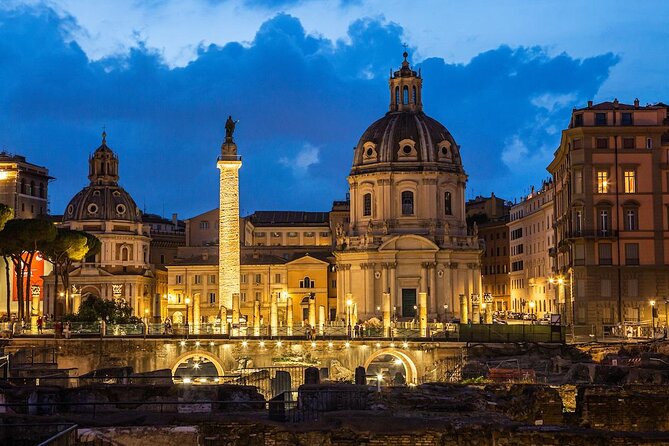
Review · ROME
Trajan’s Markets & Imperial Forums Private Tour with Special Pass & PhD Guide
Trajan’s Market is the star here: a huge ancient complex of shops, offices, and apartments that feels surprisingly close to a Roman shopping center. This private 2.5-hour tour then moves through the forums built by Rome’s emperors, with a PhD guide explaining how politics, war, religion, and daily business came together in this small stretch of the city.
I like the pre-arranged Forum Pass, which removes one bit of entrance-day fuss, and I like the private format, since you can ask questions without competing with a large group. The guide is licensed and has a PhD, and one especially strong account describes the experience as an expert history lesson brought to life. The main drawback is the price: at $334.55 per person, this makes the most sense for a small group that values specialist guidance.
Key points at a glance
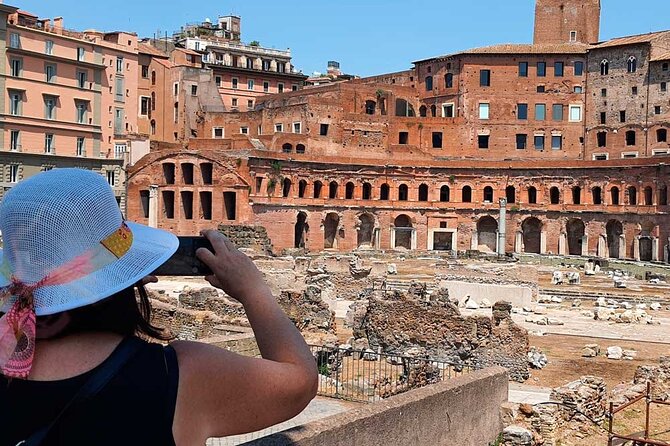
- Trajan’s Market takes center stage: Walk through one of Rome’s best-preserved ancient urban complexes, with its covered market, shops, and apartments.
- A PhD guide leads the visit: Expect strong historical context, clear explanations, and room for personal questions.
- Five ancient sites fit into one route: The tour covers Trajan’s Market, Trajan’s Column, and the Forums of Trajan, Nerva, and Augustus.
- The private format changes the pace: Only your group participates, so the visit can feel more personal than a standard group outing.
- The Forum Pass is included: Pre-arranged entry helps you get on with the archaeology instead of sorting out admission at the start.
- The price rewards group sharing: Solo visitors pay the listed per-person rate, while group discounts may improve the value.
Why Trajan’s Market is the right place to begin
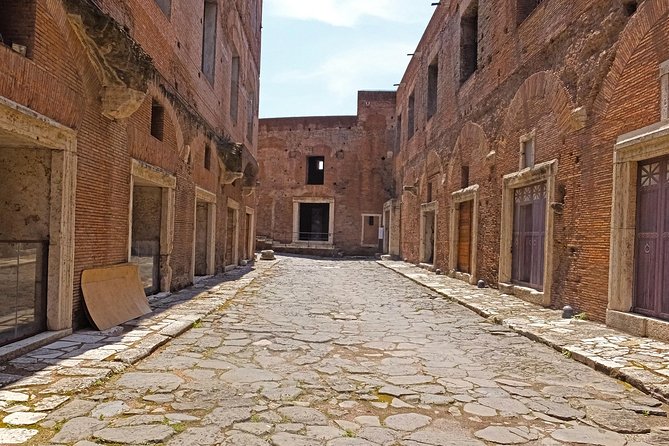
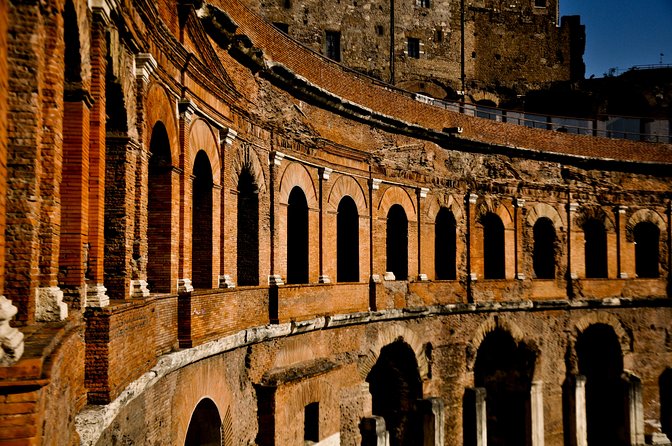
The visit starts at Mercati di Traiano, the Museum of the Imperial Fora, at 9:30 am. You’ll spend about 45 minutes among the remains, making this the longest stop and the clearest introduction to the whole area.
Trajan’s Market is often described as an early version of a modern shopping center. That comparison is useful, as long as you remember that this was not simply a row of stalls. The complex included an undercover market, small shops, and apartments, all arranged within a carefully planned urban structure.
I like beginning here because the ruins are easier to picture than a wide field of broken stones. The walls, levels, and passages give you a sense of how Roman construction worked in three dimensions. Your guide can connect the physical remains to the practical business of city life: buying goods, moving through crowded spaces, and living above or beside commercial areas.
The museum setting also gives this stop more structure than a quick look from the street. You are not just viewing Trajan’s Market from outside. You can explore the archaeological remains as part of a protected site, with the Forum Pass included in the experience.
Allow yourself to look up and around. Roman ruins are often easiest to understand when you focus on height, repeated arches, and the way rooms connect. This is also where the guide’s academic background should be most useful. A good explanation can turn a wall, staircase, or row of openings into evidence of how the complex operated.
More Private Market Tours in Italy
- Private Tour – Museum of the Imperial Forums in the Trajan Markets
★ 5.0 · 37 reviews - Rome: Private Cooking Class with Market Shopping Tour
★ 5.0 · 3 reviews - Market tour and Private Cooking Class in Rome with roman chef
★ 5.0 · 2 reviews
Trajan’s Column and the story carved into marble
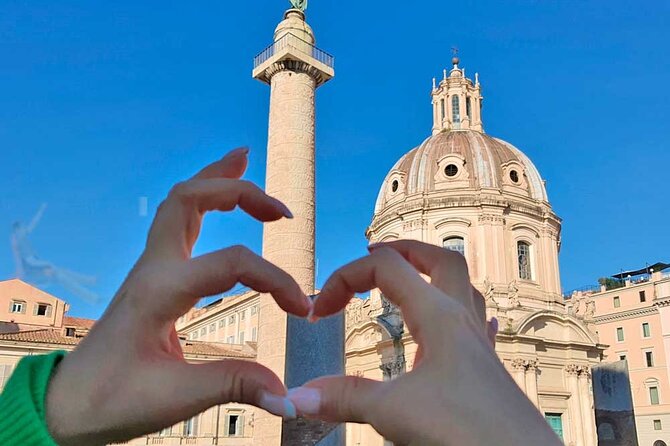
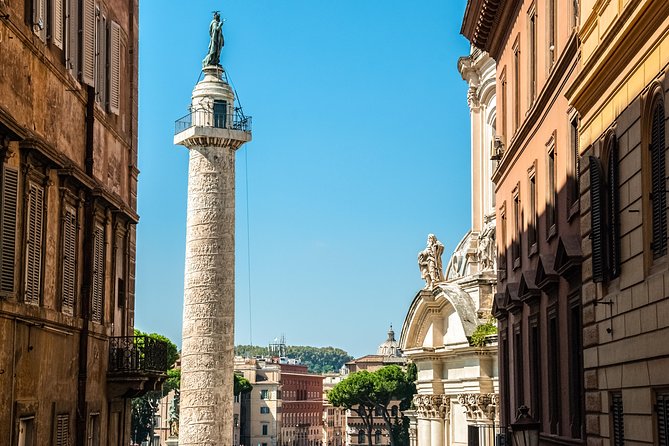
Next comes Trajan’s Column, with about 20 minutes set aside for the stop. The column is 29 meters tall and made from Carrara marble. It was built to honor Emperor Trajan’s victory over the Dacians, in the area now known as Romania.
The column’s spiral frieze is the main attraction. A carved band winds around the shaft, showing scenes from the military campaigns. From ground level, the details are difficult to see clearly, so this is a place where your guide’s explanation matters more than your ability to inspect every carving.
You’ll hear the guide point out key events and explain how the images present the battles and the emperor’s victories. This is not just a monument to military success. It also shows how Roman power was presented to the public, through a tall, carefully designed object that turned a political message into permanent stone.
Twenty minutes is enough for an explanation and a good look, but it is not enough for a slow study of every scene. If you are fascinated by ancient sculpture, you may wish the stop were longer. The tradeoff is that the tour keeps moving, allowing you to see several major forums in one morning.
The Forum of Trajan and the scale of imperial ambition
The Forum of Trajan receives another 20 minutes. It was the last and largest of Rome’s Imperial Forums, and it served as part of the political and governmental center of the Roman Empire.
The original complex included a huge basilica, two libraries, markets, and a large temple. Today, you’ll see remains rather than a complete Roman square, but the scale is still the point. The open space and surviving fragments help you picture a place designed to project order, wealth, and imperial authority.
This is where the sequence of the tour begins to make sense. Trajan’s Market shows the practical side of urban life. Trajan’s Column records military achievement. The Forum of Trajan links both ideas to public power and imperial display.
Your guide can also help you read the ruins as a connected complex instead of a set of unrelated stones. That is one of the strongest reasons to book a private visit. If you want to pause over a particular structure or ask how the forum related to the nearby market, you can do so without holding up a large group.
The limitation is simple: the forum is enormous in historical scope, but the scheduled visit is short. You’ll get a focused orientation rather than every architectural detail. For most people, that is a sensible choice during a first Roman visit.
The Forum of Nerva in a narrow ancient space
The Forum of Nerva is the smallest of the Imperial Forums and receives about 20 minutes. Emperor Domitian conceived the project, but his successor Nerva completed it in AD 97, giving the forum its name.
Unlike the broad impression created by the Forum of Trajan, this space was narrow and lined with colonnades. The surviving Temple of Minerva helps you understand the original design. Around 50 columns once formed part of the structure, but only two remain standing today.
I find this stop useful because it shows that the Imperial Forums were not all built to the same plan. The differences in size and shape reflect changing projects, emperors, and uses. Your guide can place Nerva’s Forum between the larger monuments and explain how later construction altered the area.
Twenty minutes gives you time to see the remaining columns and hear the story behind the unfinished-looking ruins. You should not expect a complete reconstruction. The pleasure here comes from matching the surviving pieces to the original design in your mind.
The narrow setting can also make the structure feel more intimate than the larger forums. That does not mean the site is more important than Trajan’s Forum, but it offers a useful change of scale halfway through the tour.
Same stalls, a different way to shop and eat:
- Rome: Colosseum, Roman Forum & Trajan’s Market Exterior Tour
★ 4.3 · 2,038 reviews - Taste of Testaccio: Special 15 Year Anniversary Edition
★ 5.0 · 1,658 reviews - Roman Food Tour with Visit to the Trionfale Food Market
★ 5.0 · 471 reviews - Authentic Roman Cooking Class & Market Experience
★ 5.0 · 363 reviews
The Forum of Augustus and the Temple of Mars Ultor
The final stop is the Forum of Augustus, also scheduled for about 20 minutes. Octavian Augustus built the forum, which includes the remains of the Temple of Mars Ultor, or Mars the Avenger.
What you can see today includes the temple’s high podium and front steps, several column bases, and three impressive Corinthian columns of white marble. These fragments are enough to suggest the original height and decoration, even though the complete forum is gone.
This stop brings the tour back to the relationship between architecture and political messaging. Augustus was Rome’s first emperor, and the temple was not an ordinary religious building. Its name, Mars the Avenger, connected the monument with military power and the idea of justice carried out on behalf of Rome.
I like ending here because the site leaves you with a strong visual image: white marble columns rising from the remains of the temple platform. The stop is brief, so listen closely when the guide explains what belongs to the temple and what belongs to the wider forum.
What the private PhD guide adds
The guide is a licensed professional with a PhD, and that combination is central to the experience. The strongest praise centers on the guide’s ability to make the subject feel like a living history lesson while remaining personable.
That matters at these sites. The ruins are important, but they do not always explain themselves. You need help connecting an empty podium with a temple, a column with a war, and a market wall with ordinary urban life.
A private guide also gives you more control than a standard group visit. Only your party participates, so you can ask for clarification, spend a little longer on a favorite monument, or keep the pace moving if you already know some Roman history.
The information provided does not name the individual guide, so you should not expect to select a specific person when booking. What you can expect is a licensed PhD guide assigned to your private group. Since the tour’s quality depends heavily on the guide’s presentation, the academic background is a meaningful part of the price.
The $334.55 price and who gets good value
At $334.55 per person, this is an expensive way to see the Imperial Forums. The value depends heavily on how many people share the private booking and how much you want specialist instruction.
For a small group of history enthusiasts, the cost may be reasonable. You are paying for private attention, a licensed guide with a PhD, and included admission through the Forum Pass. You are also fitting five connected archaeological sites into a single, organized morning.
For a solo visitor, the price is harder to justify unless expert guidance is a major priority. The tour does offer group discounts, but the exact discount is not provided, so check the final price for your party before deciding.
The tour does not include snacks, soda, or private transportation. That is easy to manage, but plan accordingly. The meeting point is at Via Quattro Novembre, 94, and the tour ends on Via dei Fori Imperiali, near the ancient monuments. The starting point is close to public transportation, which makes arrival simpler, but you need to arrange your own way there.
Timing, walking, and practical planning
The experience begins at 9:30 am and lasts about two and a half hours. That timing works well if you want to keep the rest of the day open for another Roman sight, lunch, or a slower walk through the historic center.
The five stops are close enough to form one connected archaeological route, but you should still expect to walk between them and around uneven ancient remains. The available information does not give a precise walking distance or surface description, so plan for a site visit rather than a seated lecture.
Most people can participate, and service animals are allowed. Since this is an archaeological area, you may find that the ground and access points vary from one section to another. If you have specific mobility needs, confirm the details before paying, as the tour information does not describe full accessibility.
The tour is non-refundable and cannot be changed after booking. That makes it important to confirm your date, start time, and party size before purchase.
Who should book this Imperial Forums tour?
I would choose this experience if you have limited time in Rome and want one guided visit that ties several monuments together. It is also a strong match for anyone who wants historical explanation rather than a quick photo stop.
The private format suits families, couples, and small groups with shared interests. You can ask questions freely, and the guide can shape the discussion around architecture, Roman politics, military history, or daily life.
I would think twice if you prefer to explore slowly and independently. The tour gives each major stop a set amount of time, and the price is high for a short visit. It is also not the right choice if you are looking for food, transportation, or a full-day tour of ancient Rome, since none of those extras are included.
Should you book it?
Book this tour if the idea of understanding Rome’s Imperial Forums appeals more than simply seeing them. The combination of a private group, a licensed PhD guide, included Forum Pass, and a tight route through five major sites gives you a focused introduction to one of the city’s most important archaeological areas.
Skip it if you are watching your budget, prefer self-guided sightseeing, or want a longer and slower exploration. For a small group that values expert storytelling and has only one morning available, the cost can be worthwhile. For everyone else, the decision comes down to how much personal guidance you want among the ruins.
FAQ
How long does the tour last?
The tour lasts approximately two hours and 30 minutes.
What time does the tour start?
The tour starts at 9:30 am.
Where does the tour begin?
The meeting point is Via Quattro Novembre, 94, 00187 Roma RM, Italy.
Where does the tour end?
The tour ends on Via dei Fori Imperiali in Rome.
What sites are included?
The route includes Trajan’s Market, Trajan’s Column, the Forum of Trajan, the Forum of Nerva, and the Forum of Augustus.
Is admission included?
Yes. Admission through the Forum Pass is included.
Is the tour private?
Yes. Only your group participates in the activity.
Who leads the tour?
A licensed tour guide with a PhD leads the experience.
Is transportation included?
No. Private transportation is not included, so you must arrange your own way to the meeting point and from the end point.
Can I cancel or change the booking?
No. The experience is non-refundable and cannot be changed for any reason after booking.
More Private Market Tours in Rome
- Cairo 8 Hour Private Tour of Pyramids, Egyptian Museum and Bazaar
★ 5.0 · 2,931 reviews - Private Excursion to Maeklong Railway and Floating Markets
★ 5.0 · 850 reviews - Floating and Railway Market (Optional Waterfall): Private Tour
★ 5.0 · 827 reviews - Cairo: Private Pyramids, Museum & Bazaar Tour with Lunch
★ 4.6 · 744 reviews
Just added around Rome
- Testaccio Experience: Street Food, Market and Traditions★ 5.0 · 4 reviews
- Rome: Temples, Squares & Markets Guided Walking Tour★ 4.8 · 26 reviews
- Rome: Testaccio Food & Market Tour with Pasta & Wine★ 5.0 · 38 reviews
- Rome: Trajan’s Markets & Museum of The Imperial Fora Tour★ 4.8 · 4 reviews
- Rome: Taste of Testaccio Food & Market Tour★ 4.9 · 38 reviews
- Rome: The Vatican Market Experience Tasting and Class★ 4.7 · 10 reviews
- Farmers Market Shopping and Roman Full Course Class – SHARED★ 5.0 · 12 reviews
- Rome: Market and Cooking Class at a Local’s Home★ 4.0 · 3 reviews
Private Market Tours, compared.

Private Excursion to Maeklong Railway and Floating Markets
Read our review →
Floating and Railway Market (Optional Waterfall): Private Tour
Read our review →
Private Pyramids, Museum & Bazaar Tour with Lunch
Read our review →
Shopping in the Souks of Marrakech Private Tour
Read our review →
Local Markets & Khan el Khalili Private Shopping Tour
Read our review →
Private Excursion to Floating Market and Ayutthaya World Heritage
Read our review →
Private Heritage Walking Tour in Jaisalmer Fort and Old Bazaar
Read our review →Browse the lists this tour appears in