
Review · SEOUL
Cook 3 Authentic Korean Dishes with Local Market Tour
The best part of this Seoul cooking class happens before the cooking starts. You meet Jomin at Mangwon Station, walk through a real neighborhood market, taste street food, and see the ingredients that later appear in your meal. Then you return to a tidy studio and prepare three Korean dishes at your own cooking station.
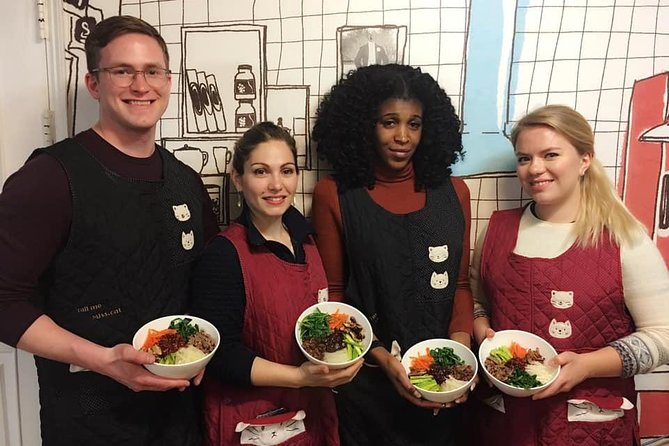
I like the small class format, advertised for no more than four people, because it leaves room for questions and hands-on help. I also like the practical finish: you eat your meal, pack up leftovers if there are any, and take home a professionally designed cookbook.
The main point to check is the menu. Dishes vary, and some classes include seafood or meat. Vegetarian and vegan options are available, but tell the provider about your needs in advance. The activity also requires a minimum of four participants and can be rescheduled if that number is not reached.
Key points to know before booking
- Mangwon Market comes first: You’ll meet at entrance 2 of Mangwon Metro Station and tour the market before cooking.
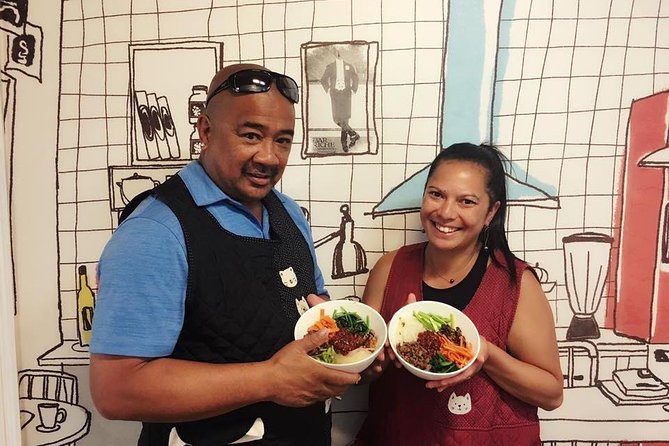
- You do the cooking: This is a hands-on class, not a demonstration from the sidelines.
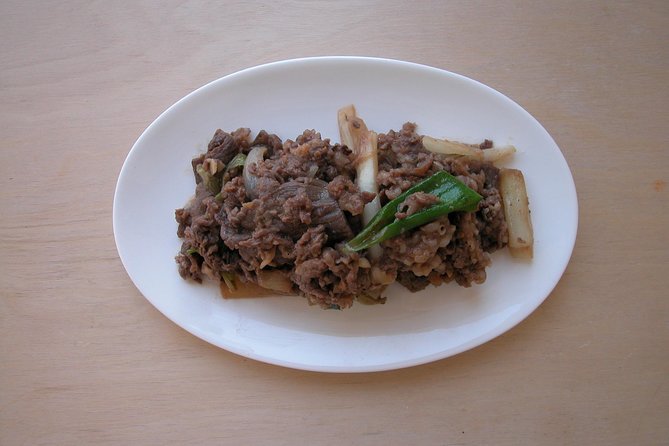
- Three Korean dishes are included: Possible dishes include bibimbap, bulgogi, soft tofu stew, japchae, kimchi stew, and stir-fried pork.
- Jomin leads the class: Her instructions cover ingredients, cooking methods, and Korean food customs.
- Your meal is part of the experience: You eat the dishes you prepare, with leftovers to take away when available.
- Plan for three and a half hours: Lunch and dinner class times give you a choice of when to fit it into your Seoul schedule.
Starting at Mangwon Market in western Seoul
Meet Jomin at Mangwon Station, entrance 2, on Line 6. This is a useful meeting point because you do not have to search for a private studio in an unfamiliar neighborhood. The tour ends back at the same meeting point.
From the station, Jomin leads you into Mangwon Market. This is not just a quick walk past food stalls. She points out ingredients used in the class, explains Korean food customs, and gives you time to look at local products and street food. Depending on the menu, you might see or buy items such as soft tofu, clams, prawns, anchovies, vegetables, or other ingredients used to build Korean flavors.
I like this beginning because it gives the cooking class a clear setting. You are not simply handed premeasured ingredients in a room. You first see how Korean food appears in an everyday market, then learn how those ingredients are used at the stove.
The market visit also helps if Korean food is new to you. Jomin explains items such as banchan, kimchi, rice wine, and the ingredients used for stock. You can ask basic questions without feeling out of place, and you get a better sense of how many Korean meals are built around several small dishes rather than one large plate.
The market is still a working local market, not a polished food museum. Some stalls may be closed on holidays such as Chuseok, so the visit can vary by date. Even then, the market walk remains useful, but you should not expect every stall to be open or the same selection every time.
More Local Market Tours in Seoul
- Fortress Night Hike & Snack at a Local Market
★ 5.0 · 112 reviews - Seoul: Gyeongbok Palace, N Tower, & Local Market City Tour
★ 4.9 · 107 reviews - Korean Cooking Class with Grocery Shopping at Seoul Local Market
★ 5.0 · 107 reviews
A personal station instead of a cooking demonstration
At the studio, you get set up at your own cooking table and cooker. The class is designed for active participation, so you cut, mix, season, and cook rather than watch Jomin prepare everything while you stand nearby.
That distinction matters. A demonstration can be entertaining, but it does not always leave you able to repeat the dish at home. Here, the process is broken into manageable steps. Jomin explains the ingredients and cooking order, then helps you as you work.
The class suits beginners particularly well. Instructions are clear, and the pace allows time to prepare several dishes. You might also appreciate the format if you already cook, since you can ask about seasoning, stock, cutting methods, or substitutions.
The studio itself is described as clean, organized, and spacious. That makes a difference when several dishes are being prepared at once. Some classes use a separate dining area, so you can sit down to eat one course while the next preparation is being arranged.
Jomin’s teaching style is warm but attentive. One useful detail from the class experience is that she may correct your technique rather than simply let you continue. If you want total freedom in the kitchen, that could feel a little strict. If you want to learn a method you can repeat, the guidance is a benefit.
What three Korean dishes may look like
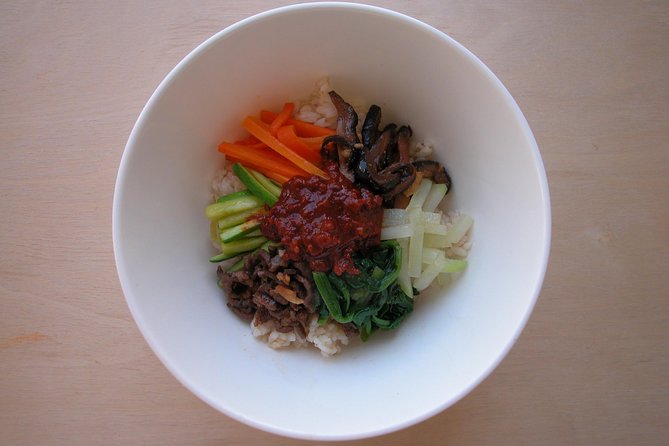
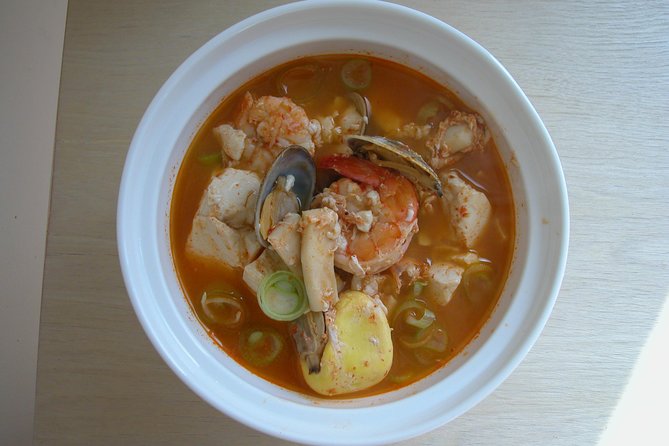
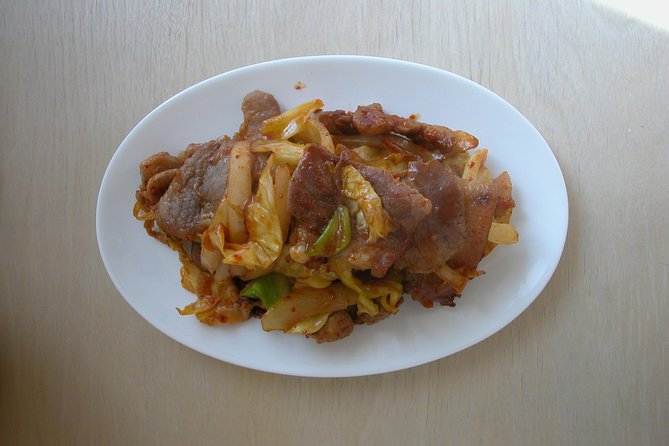
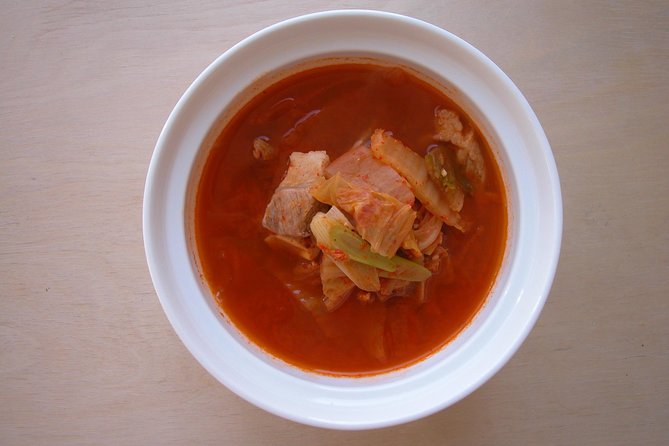
The exact menu can change, so you should not book this expecting one fixed combination. Possible dishes include soft tofu stew, bibimbap, bulgogi, kimchi stew, japchae, and stir-fried pork.
A sample combination described in the class is sundubu jjigae, bibimbap, and bulgogi. That is a well-rounded introduction to Korean cooking. The soft tofu stew shows you how broth, seafood or other proteins, and soft tofu come together. Bibimbap introduces seasoned vegetables, rice, and careful preparation of separate components. Bulgogi focuses on a sweet and savory marinade and the cooking of thinly sliced beef.
Other combinations offer a different lesson. Japchae teaches you how to handle glass noodles and vegetables, while kimchi stew gives you a more robust, sour, and spicy style of Korean comfort food. Stir-fried pork brings another method and a stronger flavor profile.
The work is not necessarily done in one long sequence. You may prepare a marinade first, cook the stew, eat it, and then move on to the next dish while ingredients are reset at your station. This makes the three-and-a-half-hour schedule feel more relaxed than a single rushed cooking project.
The final meal is one of the strongest parts of the experience. You eat food you prepared yourself, which lets you judge the seasoning and texture right away. Take-home containers are available for leftovers when there is extra food, a handy touch if the class leaves you full before every dish is finished.
Food culture beyond recipes
This experience is more than a list of cooking instructions. Jomin explains Korean food culture and the role of familiar ingredients. You learn about banchan, kimchi, stock, anchovies, prawns, rice wine, and the way a Korean meal can combine several dishes at the table.
That context helps you order food later in Seoul. After the class, terms that may have looked unfamiliar on a menu become easier to recognize. You also understand why stock and seasoning matter, rather than treating each recipe as a set of disconnected steps.
The market walk makes this information easier to remember. Seeing ingredients in their everyday setting gives you a reference point when you visit another market or grocery store. I consider this more useful than a class that focuses only on recipes and leaves out the food culture around them.
You also receive a recipe book to take home. It includes the dishes prepared in class and additional Korean favorites. This adds real value for anyone who wants to cook the food again instead of leaving the recipes behind in Seoul.
More Local Market Tours in South Korea
- Seoul Night “Private Tour”(Korean BBQ, N-Tower, Seoul Fortress, Local Market)
★ 4.5 · 86 reviews - Fortress Night Hike & Snack at a Local Market
★ 5.0 · 10 reviews
Vegetarian, vegan, and dietary needs
Vegetarian and vegan options are available. Dietary restrictions can also be accommodated, but you should communicate them before the class rather than waiting until you arrive.
This matters because the possible menu includes beef, pork, seafood, and ingredients used in Korean stock. Some dishes may be easy to adjust, while others need a different base or protein. Early notice gives Jomin a chance to prepare the right ingredients.
If you are not sure what is included in your menu, ask before booking. The class description lists several possible dishes rather than promising one exact selection. That flexibility is useful, but it means you should not assume a particular stew or noodle dish will be served on your date.
Is $79 a fair price?
At $79 per person, this is not the cheapest way to eat Korean food in Seoul. You can buy a filling market meal for much less. The value comes from the combination of a market tour, three dishes, instruction, ingredients, a full meal, and a cookbook.
The personal cooking station is important here. You are paying for direct participation and help, not simply admission to a group demonstration. The advertised class size of four or fewer should also make it easier to ask questions and receive corrections.
The activity information separately lists a maximum of 11 participants, so I would confirm the group size when booking if a very small class is important to you. The class itself is presented as a maximum-four experience, but this additional capacity note is worth clarifying.
For someone who wants a meal and a cultural activity in one block, the price is reasonable. You spend about three and a half hours learning, cooking, and eating. For a couple or family that already has a full Seoul itinerary and only wants a quick recipe lesson, it may feel like a large time commitment.
Who will enjoy this class most?
I would recommend it to first-time visitors who want a friendly introduction to Korean food without committing to a formal culinary school. Beginners get clear instructions, and experienced home cooks can ask about ingredients and methods.
It is also a good fit for people who prefer local neighborhoods to major sightseeing sites. Mangwon Market offers a look at daily food shopping and street snacks, while the studio provides a comfortable place to cook and eat.
Families, couples, and small groups should find the format easy to enjoy. The activity is social, but the personal workstation gives you something practical to do. If you are traveling alone, the small class may still work well, especially if you like meeting people through a shared meal.
This is less suitable if you dislike meat or seafood and do not want to discuss substitutions. It is also not the best choice for anyone looking for a fixed menu, a fast activity, or a purely guided food tasting with no cooking.
Timing, booking, and cancellation details
Choose a lunch or dinner class. The activity lasts about three hours and 30 minutes, including the market visit, cooking, and meal.
You receive confirmation when booking, and the meeting point is near public transportation. A mobile ticket is provided, so you can keep the booking on your phone.
Free cancellation is available if you cancel at least 24 hours before the start time. Changes or cancellations made within 24 hours are not accepted for a refund. Since the class requires at least four participants, the provider may cancel or reschedule if that minimum is not met. In that case, you are offered another date or experience, or a full refund.
FAQ
Where does the Korean cooking class meet?
You meet Jomin at entrance 2 of Mangwon Metro Station in Seoul. The activity ends back at the meeting point.
How long does the experience last?
The class and market visit take approximately three hours and 30 minutes.
How many people are in the cooking class?
The class is described as a small-group experience with a maximum of four people. The additional activity information lists a maximum of 11 travelers, so confirm the expected group size if this is important to you.
What dishes will I cook?
The three-course menu may include soft tofu stew, bibimbap, bulgogi, kimchi stew, japchae, or stir-fried pork. The exact dishes can vary.
Are vegetarian and vegan options available?
Yes. Vegetarian and vegan options are available. Share your dietary requirements in advance so the class can be prepared appropriately.
Can I cancel for a full refund?
Yes, if you cancel at least 24 hours before the experience start time. Cancellations made less than 24 hours before the start time are not refunded. If the provider cancels because the minimum number of participants is not met, you receive an alternative option or a full refund.
Should you book it?
Book this class if you want to understand Korean food by handling the ingredients, cooking the dishes, and eating the results. The Mangwon Market visit, personal station, patient instruction, and take-home cookbook give it more substance than a short cooking demonstration.
I would especially choose it early in a Seoul trip. The market tour can help you recognize ingredients for the rest of your visit, and the class gives you an easy first look at Korean meal customs.
Skip it if you want a fixed menu, a brief food stop, or a completely private class without any chance of scheduling changes. For most curious eaters, though, the mix of market, kitchen, and meal makes $79 a fair price for a useful half-day experience.
More Shopping Tours in Seoul
- Seoul: Korean Cooking Class at a Local Home and Market Tour
★ 5.0 · 348 reviews - Seoul: Guided Food & Market Tour with 8+ Tastings
★ 4.9 · 342 reviews - Seoul Night Palace & Market Food Tour with Vehicle
★ 5.0 · 275 reviews - Korean Palace and Market Tour in Seoul Including Insadong and Gyeongbokgung Palace
★ 4.0 · 174 reviews
More Markets in Seoul
- Seoul Street Food Market Tour
★ 5.0 · 1,226 reviews - Local Home Korean Cooking Class & Market Adventure in Seoul
★ 5.0 · 1,024 reviews - Seoul: Night Market Food Tour with Local Guide
★ 4.9 · 943 reviews - Seoul: Palace, Temple and Market Guided Foodie Tour at Night
★ 4.9 · 750 reviews
Just added around Seoul
- Seoul: Sokcho beach, market, hot spring and Seorak Cable Car★ 4.8 · 5 reviews
- Seoul: The Biggest Sea-food Noryangjin Market Tour★ 4.3 · 30 reviews
- Seoul: Namdaemun Market Food Tour★ 4.9 · 34 reviews
- Seoul: Guided Street Food Tour at Namdaemun Market★ 5.0 · 10 reviews
- Seoul: Gwangjang Market Vegan & Vegetarian Food Tour★ 5.0 · 16 reviews
- Seoul: Gyeongbokgung Palace Tour & Lunch at Authentic Market★ 4.5 · 2 reviews
- Seoul Evening Tour:Gwangjang Market&Naksan Park&Eungbongsan★ 5.0 · 2 reviews
- Seoul Gwangjang Market Foody Walking Tour★ 4.1 · 7 reviews
Local & Farmers Market Tours, compared.
Hanoi Cooking Class: Culture, Local Market & Meaning CSR Impact
Read our review →
Cooking Class and Lunch at a Tuscan Farmhouse with Local Market Tour from Florence
Read our review →
Cooking Class Hoi An:Local Market, Basket Boat, Fishing & Cooking
Read our review →
Hoi An Cooking Class(Local market,Basket Boat,Fishing & Cooking)
Read our review →
Old Dubai tour: Local Market, Tasting, Dubai creek with Abra ride
Read our review →
Half Day Easy Thai Cooking Class & Local Market Tour
Read our review →
Cancun Street Food Tour with Food Stalls, Local Market and Murals
Read our review →
Browse the lists this tour appears in