
Review · ROME
Rome: Trajan Markets Experience with Multimedia Video
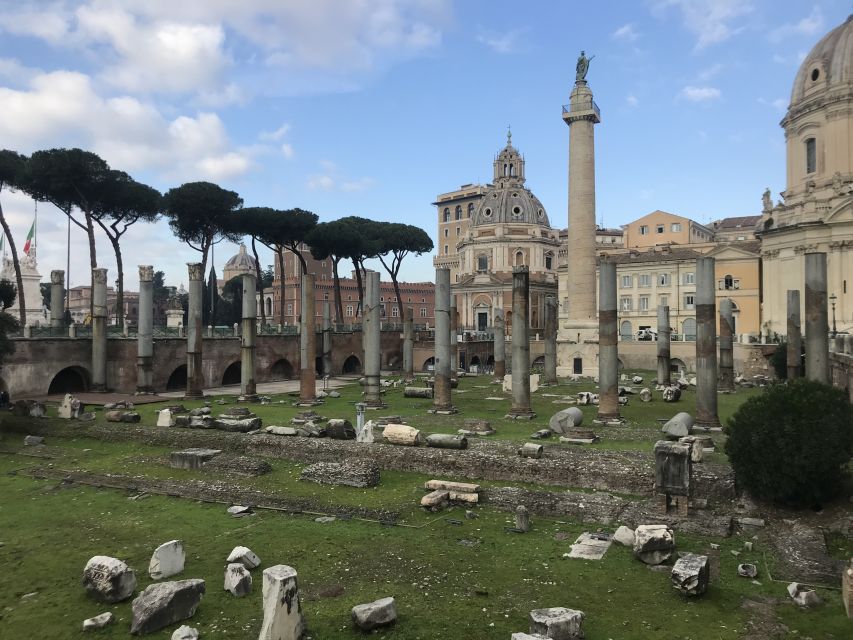
Rome’s Trajan Markets were the shopping and business center of the Imperial city, and the curved brick complex still gives you an unusually clear sense of how Roman commerce worked. You’ll also see Caesar’s, Augustus’, Nerva’s, and the Templum Pacis forums, plus museum displays that trace how this corner of Rome changed over the centuries.
I like the 25-minute video, which helps you picture the monuments before you walk among their remains. I also like the freedom of the app, with more than 170 points of interest to explore at your own pace. The main caution is the meeting point: ticket collection can be slow and confusing, so allow extra time before your entry.
Key points
- See Rome’s ancient shopping district: Walk through the Trajan Markets, a large commercial complex from the Imperial Age.
- Watch the city rebuild itself: A short multimedia presentation reconstructs major Roman monuments before your visit.
- Compare several imperial forums: Caesar’s, Augustus’, Nerva’s, and the Templum Pacis each add a different layer to the site.
- Use an app instead of a live guide: The downloadable city guide includes more than 170 listening points on your smartphone.
- Find later history among the ruins: A 17th-century cistern shows that this area kept changing long after the Roman period.
- Look for ancient containers and artifacts: The Fori Imperiali Museum includes objects from ancient cultures and amphorae.
What the Trajan Markets reveal about daily Roman life
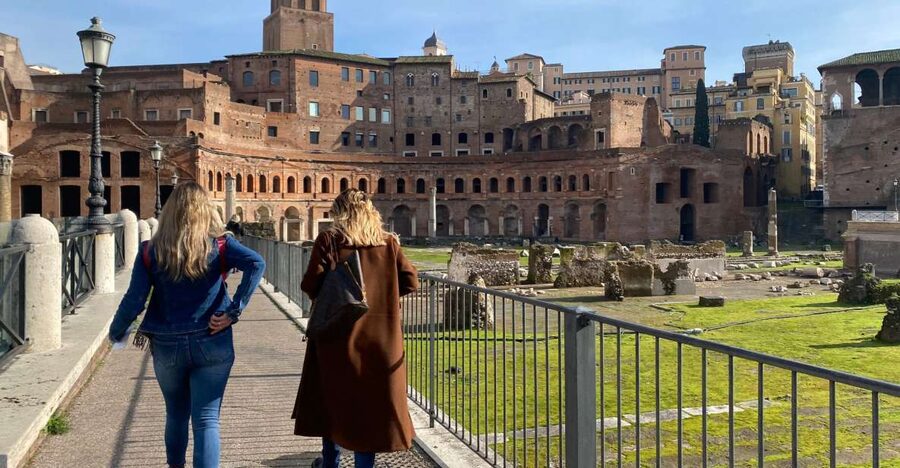
The Colosseum gets the crowds, but Trajan Markets offer a more practical look at Rome. This was not simply a grand monument built for display. It was a working commercial complex, linked to the wider group of imperial forums and used for trade, business, and meetings.
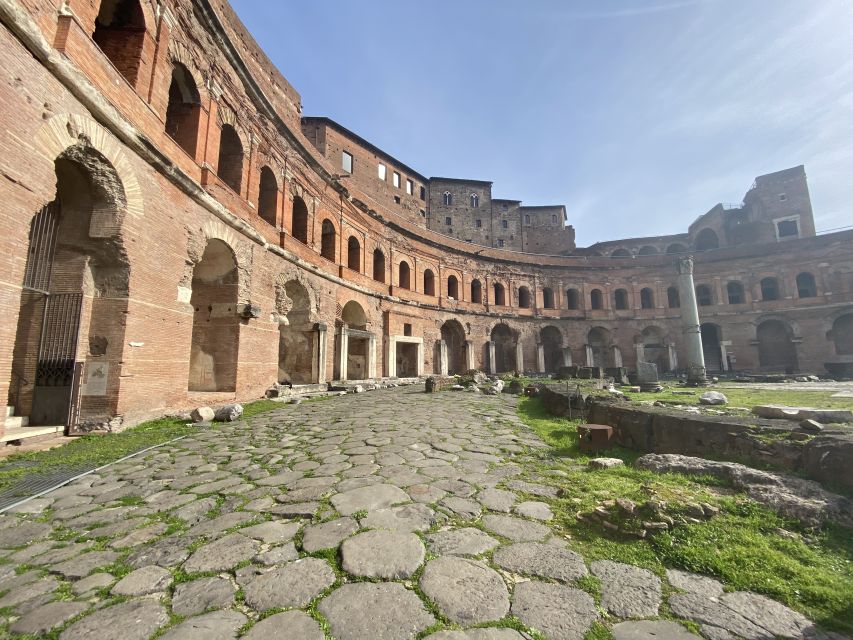
The site’s famous semi-circular shape is one of its best features. The curve follows the slope of the hill and creates a strong architectural setting, with several levels of brick structures arranged around an open area. From here, you can think about Rome not only as the home of emperors and temples, but also as a city where people bought goods, handled business, and moved through crowded public spaces.
I find this focus useful because it puts Roman power into ordinary terms. Imperial Rome needed markets, storage, offices, and meeting places to function. Trajan Markets helps you see that machinery behind the marble monuments.
The complex also shows how the city changed after the Imperial Age. Ruins from a 17th-century cistern remain in the area, a reminder that later residents reused and adapted old Roman spaces. That small detail adds weight to the visit. You are not looking at a frozen Roman scene, but a site with many chapters.
A few more market tours around Rome worth a look
- Rome: Colosseum, Roman Forum & Trajan’s Market Exterior Tour
★ 4.3 · 2,038 reviews - Taste of Testaccio: Special 15 Year Anniversary Edition
★ 5.0 · 1,658 reviews - Roman Food Tour with Visit to the Trionfale Food Market
★ 5.0 · 471 reviews
Start with the 25-minute Ancient Rome reconstruction
Your visit begins with a multimedia video lasting about 25 minutes. It uses reconstructions of Rome’s major monuments to show how the city may have looked during the Imperial Age.
This is a good first step if Roman ruins usually leave you guessing. Walls and foundations can be hard to read, especially when you are seeing several forums in one area. The video gives you a visual frame before you enter the archaeological complex, so you can connect the remains with the buildings and public spaces they once formed.
The presentation is not a guided walk. It is an introduction, and you should treat it that way. You will still need to spend time at the site, listen through the app, and make sense of what remains in front of you. Still, the short format makes it easy to fit into a day of sightseeing without taking over your schedule.
I especially like the order of the experience. First, you get a broad picture of Ancient Rome. Then you move into one specific part of the city and examine it more closely. That progression works better than arriving cold and trying to identify every arch, wall, and forum at once.
Walking through Trajan Markets and its curved brick buildings
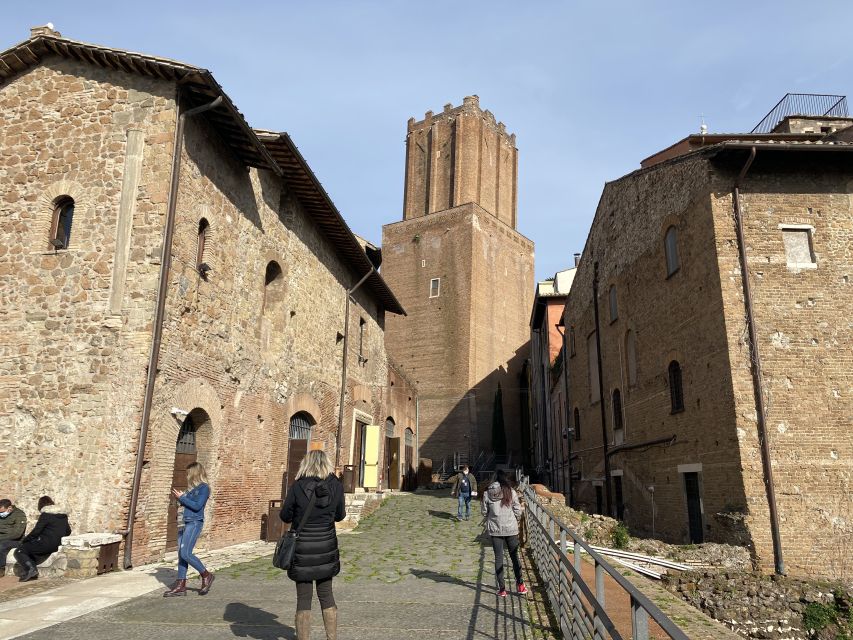
After the video, you enter the Trajan Markets archaeological complex. This is the central part of the experience, and you should allow yourself time to look beyond the obvious photo spots.
The curved architecture is the main visual prize. The shape is dramatic, but it also tells you something about Roman engineering and urban planning. The complex was built into the side of a hill, so the different levels and connected spaces are part of the story. Take a moment to look at how the rooms relate to one another rather than rushing from one viewpoint to the next.
The markets were associated with trade and commerce during the Roman Imperial Age. The site gives you a useful counterpoint to Rome’s temples and triumphal monuments. Here, the subject is less about one emperor’s victory and more about the systems that kept the city operating.
You may find the experience more rewarding if you arrive with a few questions. How were goods handled? How did people move between the levels? Which spaces seem designed for public activity, and which feel more private or functional? The app can help with these points, but your own observation matters too.
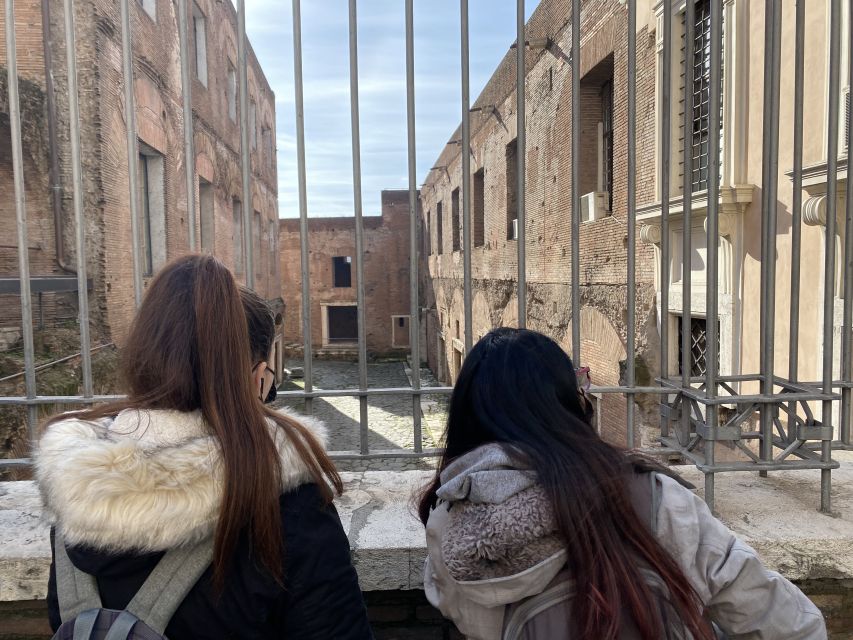
A practical limitation is that some of the complex can be seen from the surrounding streets. One purchaser felt that much of the site was visible without entering, which is a fair point. The ticket makes more sense if you want to walk inside the archaeological area, examine the structures closely, and visit the museum. If you only want a quick look at the exterior, the value is weaker.
Four imperial forums in one compact visit
The experience also introduces several forums that served as trading and meeting areas in Ancient Rome. You will encounter Caesar’s Forum, Augustus’ Forum, Nerva’s Forum, and the Templum Pacis.
Each name can blur together if you are touring Rome at speed. The app is useful here because it lets you separate the places and follow points of interest one at a time. You can stop, listen, look around, and continue when you are ready rather than keeping up with a live group.
The forums also show how Roman rulers used public construction to shape the city. Their buildings were places for commerce, official business, religion, and public gatherings. The experience does not ask you to treat the forums as isolated ruins. It presents them as connected pieces of a larger urban center.
This is one reason I would pair the visit with a little patience. The visual remains may not deliver an instant spectacle at every turn. Some sections require you to use the video, app, and imagination together. In return, you get a better sense of how the Imperial city was organized.
Same stalls, a different way to shop and eat:
- Authentic Roman Cooking Class & Market Experience
★ 5.0 · 363 reviews - Trevi Fountain, Pantheon, and Campo Dei Fiori Market Food and Wine Tour
★ 5.0 · 320 reviews - Rome: Pasta Cooking Class with Market Visit and Wine
★ 4.9 · 277 reviews - Rome: Food Tour with Market Visit
★ 4.9 · 200 reviews
The 17th-century cistern and the later life of the site
The cistern is a small but revealing feature. It dates from the 17th century, long after the imperial forums had lost their original role.
I like details such as this because they prevent the visit from becoming a single-period history lesson. Rome did not stop changing when the emperors disappeared. Old structures were reused, modified, and absorbed into later city life.
You might pass the cistern quickly if you are focused only on Roman remains. I suggest treating it as evidence of continuity. The area had different functions over time, and this later structure helps explain why archaeological sites in Rome often contain several historical periods in the same few steps.
The Fori Imperiali Museum and its ancient artifacts
After the outdoor and archaeological portion, you visit the Fori Imperiali Museum. The museum includes artifacts from different ancient cultures and a collection of amphorae.
The amphorae are particularly helpful because they connect the grand forums with trade. These large ceramic containers were used to transport and store goods, so they fit naturally with the commercial focus of Trajan Markets. They give you a more tangible link to the movement of products through the Roman world.
The museum also broadens the visit beyond architecture. At the markets, you are mainly reading buildings, walls, and spaces. In the museum, you can examine objects that show how people made, stored, and used things.
Do not expect a huge museum visit. The appeal is its connection to the archaeological complex rather than its size. I would plan to see the museum after walking the site, when the artifacts can help reinforce what you have just seen outside.
How the smartphone app changes the visit
There is no live guided tour included. Instead, you download a city app to your smartphone, with more than 170 points of interest available for listening.
This format suits you if you like setting your own pace. You can spend longer on the semi-circular market architecture, move quickly through familiar material, or pause whenever you need a break. You are not tied to a group schedule or waiting for other people to finish a stop.
Bring headphones and a fully charged phone. These are not minor suggestions. Without them, the audio portion becomes less practical, and the visit loses much of its explanatory support. You should also download or prepare the app as instructed before you need it, since a long setup process can eat into your time.
The app has a broad range of points, which is useful if you want more context around Rome beyond this one complex. It can also feel like extra material if you prefer a simple, personal visit. This is not the best choice for someone who wants a historian standing beside them and answering questions in real time.
Price, timing, and the real value at $37
At $37 per person, the price is reasonable if you plan to use all the included parts: the video, Trajan Markets entrance, Fori Imperiali Museum entrance, and smartphone guide.
The value is strongest for first-time visitors who want structure but do not want a full group tour. You get a short orientation, access to the archaeological complex, museum entry, and a self-guided audio resource. The package also lets you explore without paying for food, transport, or a hotel transfer because none of those services are included.
The value is less convincing if you only want to see the exterior. Since much of the site can be viewed from the street, you need to make use of the interior access and museum to justify the cost. You should also remember that this is valid for one day, not a multi-day pass.
The check-in process deserves attention. The meeting point is the Touristation Aracoeli Office at Piazza d’Aracoeli 16, near Piazza Venezia. Look for the orange Touristation flags and the fountain in front of the entrance.
One person successfully exchanged a voucher in the morning for an afternoon visit and found the staff welcoming, with no queue. Another person experienced at least 15 minutes of delay while tickets were printed and found the procedure confusing. I would not assume the process will always be slow, but I would arrive early enough to absorb a delay.
Who will get the most from this experience
I would recommend this to you if you enjoy archaeology, Roman urban planning, and independent sightseeing. It works especially well if you want to understand the practical side of Ancient Rome rather than see only its most famous monuments.
It is also a good fit if you prefer audio content to a live group. You can choose your own pace and use the app to add context when you want it.
Families with older children may appreciate the video and visual reconstructions, though the site still requires attention and walking on comfortable shoes. The experience is less suitable if you need wheelchair access, as it is specifically not suitable for wheelchair users.
You should also skip it if you want a fully guided tour with a named expert. No guide is included, and assistance is provided at the meeting point rather than throughout the archaeological complex.
Bring your passport or ID card, comfortable shoes, headphones, and a charged smartphone. Large bags, luggage, drones, glass objects, sprays, alcohol, drugs, weapons, sharp objects, and pets are not allowed.
Should you book Trajan Markets?
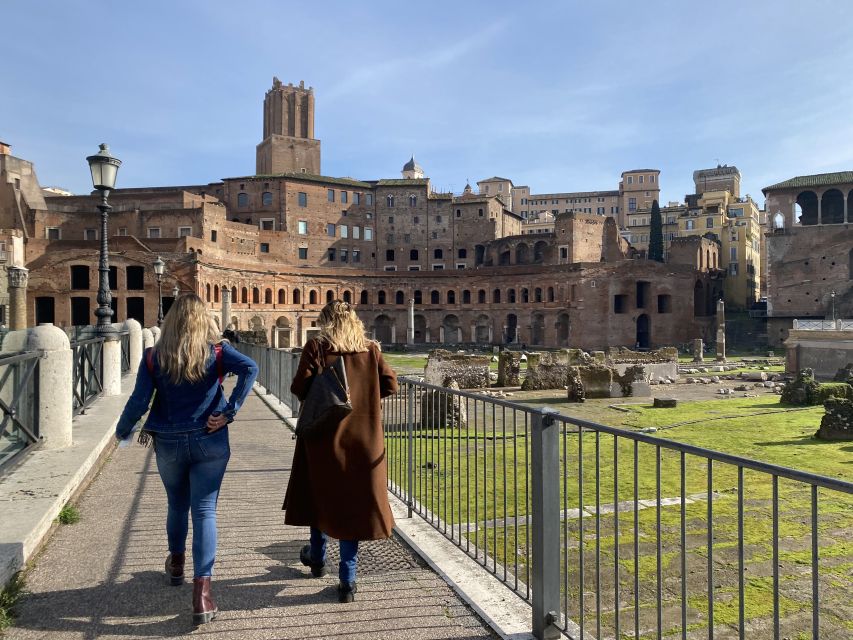
Book it if you want a focused look at Roman commerce, a useful visual introduction, and the freedom to explore without a live group. The semi-circular market architecture, the several imperial forums, and the amphorae in the museum give the visit a clear theme rather than a random collection of ruins.
Think twice if you are mainly looking for a grand exterior view or a personal historian. Much of the complex can be seen from the street, and the app requires your own phone, headphones, and preparation.
For most independent visitors, $37 is fair when you use every part of the experience. Arrive early at the Piazza d’Aracoeli meeting point, allow time for ticket collection, and treat the video and app as essential parts of the visit rather than optional extras.
FAQ
Where is the meeting point?
Meet at the Touristation Aracoeli Office at Piazza d’Aracoeli 16, near Piazza Venezia. Look for the orange Touristation flags and the fountain in front of the office.
What does the experience include?
It includes a 25-minute Ancient Rome video presentation, entry to Trajan Markets, entry to the Fori Imperiali Museum, a city app audio guide for your smartphone, and assistance at the meeting point.
Is a live guide included?
No. The experience includes a downloadable smartphone app with more than 170 points of interest, but not a guided tour led by a person.
How long is the video?
The multimedia presentation about Ancient Rome lasts 25 minutes.
What should I bring?
Bring your passport or ID card, comfortable shoes, headphones, and a charged smartphone.
Can I see the site from outside without buying a ticket?
Some of the site is visible from the street. The ticket provides entry to the archaeological complex and the Fori Imperiali Museum.
Is the experience suitable for wheelchair users?
No. The activity is not suitable for wheelchair users.
Can I cancel for a refund?
You can cancel up to 24 hours in advance for a full refund. You can also reserve now and pay later, subject to availability.
Just added around Rome
- Testaccio Experience: Street Food, Market and Traditions★ 5.0 · 4 reviews
- Rome: Temples, Squares & Markets Guided Walking Tour★ 4.8 · 26 reviews
- Rome: Testaccio Food & Market Tour with Pasta & Wine★ 5.0 · 38 reviews
- Rome: Trajan’s Markets & Museum of The Imperial Fora Tour★ 4.8 · 4 reviews
- Rome: Taste of Testaccio Food & Market Tour★ 4.9 · 38 reviews
- Rome: The Vatican Market Experience Tasting and Class★ 4.7 · 10 reviews
- Farmers Market Shopping and Roman Full Course Class – SHARED★ 5.0 · 12 reviews
- Rome: Market and Cooking Class at a Local’s Home★ 4.0 · 3 reviews
Rome Market Tours, compared.
Colosseum, Roman Forum & Trajan’s Market Exterior Tour
Read our review →
Taste of Testaccio: Special 15 Year Anniversary Edition
Read our review →
Roman Food Tour with Visit to the Trionfale Food Market
Read our review →
Authentic Roman Cooking Class & Market Experience
Read our review →
Trevi Fountain, Pantheon, and Campo Dei Fiori Market Food and Wine Tour
Read our review →
Pasta Cooking Class with Market Visit and Wine
Read our review →

Browse the lists this tour appears in