Review · TOKYO
Tokyo: Guided Walking Tour of Tsukiji Market with Lunch
Tsukiji is at its best when you stop treating it like a list of food stalls and start watching how the market works. This 165-minute walking tour takes you from the striking Tsukiji Hongwanji Temple into the narrow lanes where wholesalers, cooks, and shoppers handle Japan’s ingredients at close range. You get nine tastings along the way, including tuna sushi, yakitori or beef, omelette, dashi, tea, dessert, and more.
I like two things here. First, the small group of up to 10 makes it easier for a guide to steer you through tight market lanes and explain what you are seeing. Second, the temple stop gives the food a wider cultural setting, linking Japanese cuisine with Buddhist practice and local tradition. The main caution is value: at $113 per person, this is not a bargain food crawl, and the tastings may feel modest if you expect a full restaurant meal.
Key points at a glance
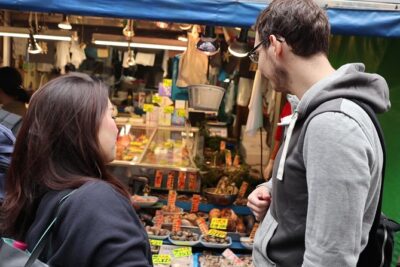
- Nine planned tastings: Expect tuna sushi, a Japanese omelette, fried fish paste, rice balls, grilled seafood or meat, dessert, a drink, Japanese tea, and dashi soup stock.
- A useful meeting point: Tsukiji Station’s Hibiya Line Exit A1 is about 50 meters from Tsukiji Hongwanji Temple.
- More than food: The guide explains how Japanese religion, history, and cuisine connect.
- Small and personal: Groups are limited to 10, with English guidance.
- A working market: You pass shops, stalls, restaurants, and wholesalers handling their trade.
- Plan for walking: Comfortable shoes matter, and the tour lasts nearly three hours.
Starting at Tsukiji Hongwanji Temple
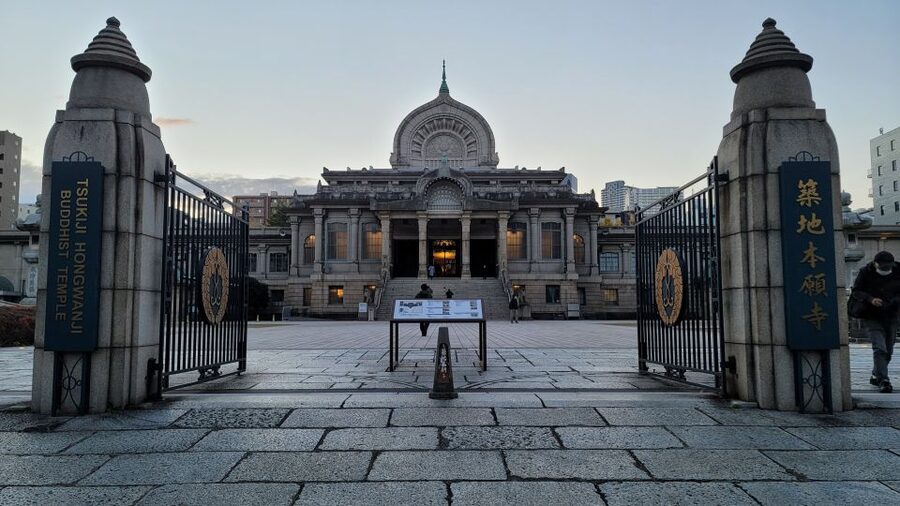
The tour begins outside Tsukiji Hongwanji Temple, a practical meeting point as well as an important first stop. From Tsukiji Station on the Hibiya Line, take Exit A1, turn left, and you will find the temple entrance about 50 meters away. That short walk makes this one of the easier Tokyo food tours to reach by subway.
Take a moment to look at the temple exterior before heading into the market. Its architecture has an ancient Indian influence, which makes it look quite different from the wooden Buddhist temples you may have seen elsewhere in Japan. The visit is exterior-only, so you are not coming for a long temple tour. Instead, the building sets the tone for the food discussion that follows.
This opening is useful because it keeps the market from feeling like a row of random snack counters. Your guide can explain how religion and food meet in Japanese culture, giving more meaning to simple ingredients, soup stock, rice, and seafood. Guides who have led this route include Hide, Tomoko, Yumiko, and others, with past groups especially appreciating clear explanations of the area’s history and customs.
More Fish Market Tours in Japan
- Tokyo Tsukiji Fish Market Food and Culture Walking Tour
★ 5.0 · 3,184 reviews - Tokyo: Tsukiji Fish Market Food and Walking tour
★ 5.0 · 1,724 reviews - Tokyo: Tsukiji Fish Market Guided Walking Tour
★ 4.9 · 1,397 reviews
Walking into the Tsukiji Outer Market
From the temple, you head into Tsukiji Outer Market. The inner wholesale fish market moved to Toyosu, but Tsukiji’s outer area remains a major food district packed with specialist shops, restaurants, stalls, and businesses serving cooks and the public.
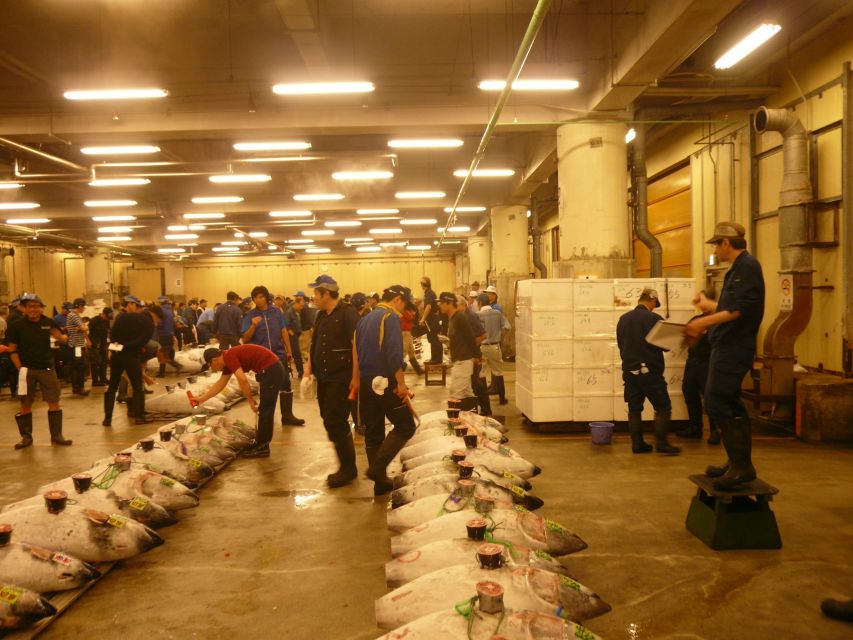
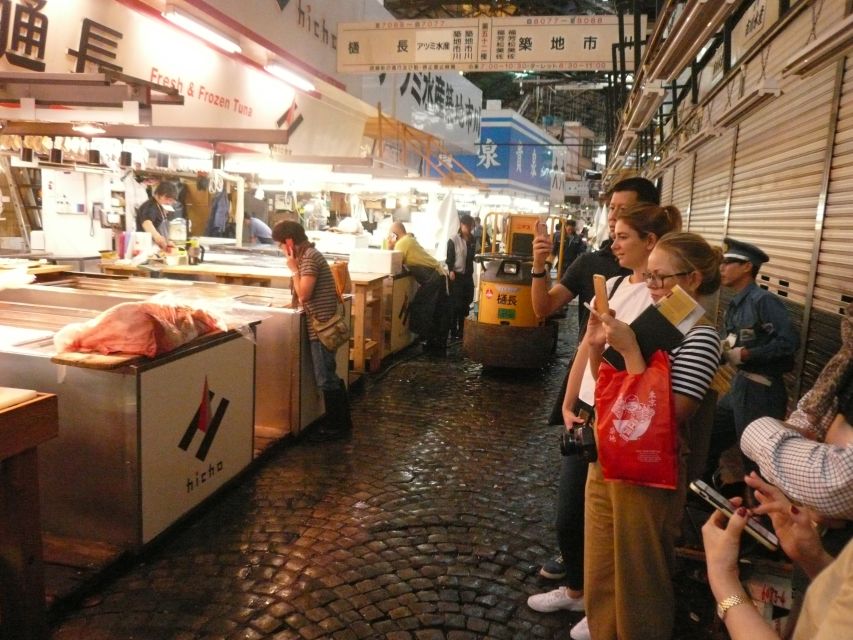
That distinction matters. You are not entering a museum display or a staged food village. You are walking through a working commercial area where people are buying, selling, preparing, and transporting food. Expert wholesalers may be busy at work as you pass, so you need to stay alert and follow the guide’s route.
I like the way a guided visit can help you notice details you would probably miss alone. A stall selling a familiar ingredient may serve professional kitchens as well as casual shoppers. A narrow passage may make more sense once you understand how the market is organized. Your guide also helps with the basic question every first-time visitor faces: What should I try, and how do I eat it without blocking the lane?
The route itself covers a fairly small area. That can be a plus if you want an easy introduction and do not want to spend half a day wandering. It can also feel limited if you expect a long expedition through every corner of Tsukiji. The tour’s value comes less from distance and more from having someone explain the products and direct you to specific tastings.
Nine tastings, with a focus on variety
The food portion is designed as a sequence of small samples rather than one large lunch. That lets you try several types of Japanese food without committing to a single restaurant or dish.
The exact order can vary, but the listed tastings include:
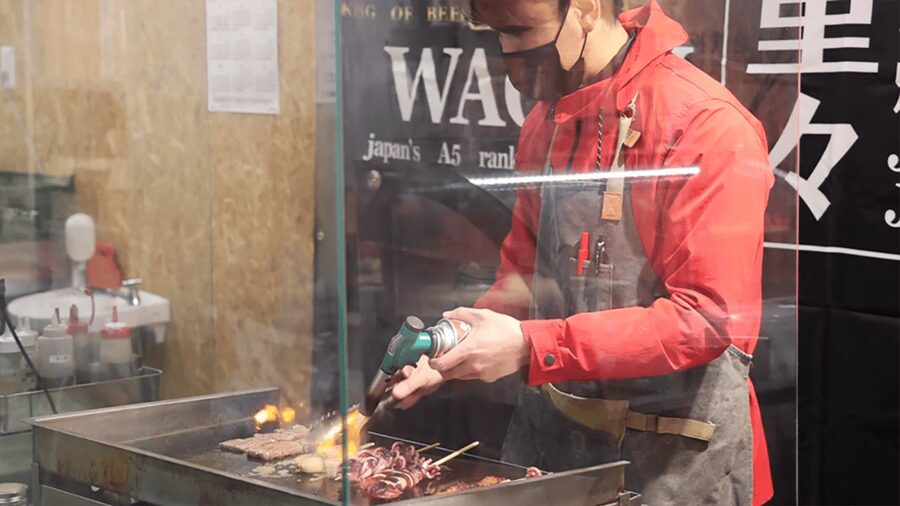
- Grilled seafood or meat skewers, with wagyu beef and yakitori-style options highlighted
- Japanese-style omelette
- Tuna sushi
- Fried fish paste skewers
- Filled rice balls
- Dessert
- A drink
- Japanese tea
- Dashi soup stock
The range is the strongest part of the food plan. You get seafood, meat, egg, rice, soup stock, a hot drink, and something sweet. For a first visit to Tsukiji, this gives you a useful survey of everyday flavors and market specialties.
The skewers are likely to be among the easiest foods to enjoy while walking. Grilled fish, beef, or chicken gives the tour a smoky, savory element, while the omelette shows a softer and slightly sweet side of Japanese cooking. Fried fish paste offers another texture, and the rice ball provides a filling item that feels closer to a practical snack than a delicate tasting.
The tuna sushi is a central part of the promise, but you should set your expectations carefully. This is not presented as an omakase meal, and the food is served as market tasting portions. Some people may find the sushi and tuna rice ball quite ordinary, particularly if they have already eaten high-quality sushi in Tokyo. The strawberry dessert mentioned by one participant also suggests that the sweet course may be simple rather than elaborate.
That is the key difference between this tour and a premium food-focused experience. You are paying for access, guidance, context, and a planned route, not just the raw cost of nine bites. If your main goal is the finest possible sushi, you may prefer to choose a respected sushi restaurant yourself. If you want help sampling several foods without having to research every stall, the structure makes more sense.
Dashi, tea, and the culture behind the food
The dashi tasting is a small but important detail. Dashi is a basic Japanese soup stock, often used as a foundation for soups, sauces, noodles, and other dishes. Tasting it on its own helps you recognize the savory depth that appears across Japanese cooking.
The tea sample serves a similar purpose. It gives you a brief introduction to a daily Japanese drink rather than treating the meal as a parade of novelty foods. These quieter tastes can be more useful than they first appear, especially if you plan to order Japanese dishes during the rest of your trip.
This is where the guide matters most. A food stall can hand you a sample, but a guide can explain why the ingredient matters and how it fits into local habits. Past guides such as Tomoko have also helped with the practical side, including waiting in line, keeping food organized, and providing boxes or cleaning wipes. Those details are not glamorous, but they make a market tasting easier, especially when you are carrying several small portions.
The route is conducted in English. Strong communication is important here because the tour depends on explanations, not only eating. One departure had some early language difficulty, so if history and cultural detail are a major reason for booking, listen carefully at the beginning and ask questions when you need clarification.
More Fish Market Tours in Tokyo
- Tokyo Sushi Making Class in Tsukiji with Professional Chef
★ 5.0 · 1,177 reviews - Tsukiji Fish Market Guided Tour and Sushi Making with Pro Chef
★ 5.0 · 775 reviews - Tokyo: Tsukiji Fish Market Food and Culture Walking Tour
★ 4.7 · 757 reviews - Tsukiji Fish Market: Street Food & Culture Walking Tour
★ 5.0 · 669 reviews
How the small group changes the experience
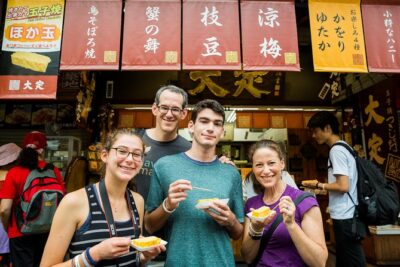
The maximum group size is 10 people. That is small enough for a guide to keep the group together in crowded lanes and to answer questions without shouting across a large crowd.
A small group also helps with food logistics. Market stalls can have limited room, and you may need to stand to one side while eating. A guide who manages queues and gathers the group can save you from making repeated decisions about where to go next.
The experience can feel relaxed when the guide keeps the pace moving without rushing. Tomoko was especially praised for making the route feel easy and for helping a returning Tsukiji visitor see the market differently. Yumiko, assisted by Sachiko, was also noted for handling the route smoothly and explaining the area’s past.
Still, a small group does not guarantee constant action. The market area covered is compact, and there may be pauses between tastings. Some people find that pleasant because it leaves time to look around. Others may feel the guide is stretching the allotted time if the group has already seen the main streets.
Is $113 a fair price?
At $113 per person, the price deserves a close look. The nine tastings alone are unlikely to justify the full cost for someone who is comfortable choosing food independently. Tsukiji has plenty of stalls and shops, and you could spend less by buying a few items on your own.
You are paying for more than food, though. The fee includes an English-speaking guide, a planned route, temple context, explanations of Japanese cuisine, help with ordering and queues, and the convenience of tasting nine specialties without building your own itinerary. The group limit of 10 also gives you a more personal experience than a large coach-style outing.
I would call the value reasonable for a first-time visitor who wants structure and cultural explanation. I would be less enthusiastic about the price for a serious food enthusiast who already knows Tsukiji and mainly wants excellent sushi. The mixed reaction to the food makes this distinction important. Some people found the whole outing excellent because of the guide and market insight. Others found the food average and the cost too high.
Think of it as a market orientation with lunch samples, not a luxury tasting menu. That description will help you decide more accurately.
Timing, footwear, and access

The tour lasts 165 minutes, or two hours and 45 minutes. That gives the guide time to cover the temple, walk through the market, explain the area, and stop for nine tastings without making the outing a full-day commitment.
Wear comfortable shoes. You will be walking through market streets and standing for food stops, and the surface can feel crowded even if the distance is not great. A small bag is easier to manage than bulky luggage, though no specific bag rule is provided.
The activity is listed as wheelchair accessible. Because this is a working market with narrow lanes, shops, and other businesses, you may still want to confirm current route conditions when booking if you need specific mobility support. The available information confirms accessibility but does not describe every surface or stall entrance.
Cancellation is free up to 24 hours before the start time, and you can reserve now while paying later. Starting times vary, so check availability for the date you want.
Who will enjoy this Tsukiji tour?
I would recommend it most strongly to first-time visitors who want a gentle introduction to Tsukiji without having to research every food counter. It also suits families, since the tastings are varied and the route combines food with a temple and local history.
It is a good choice if you enjoy asking questions, trying small portions, and learning why a dish matters. The compact route can also work well if you have other Tokyo plans later in the day.
You may want to skip it if you are seeking a long, intense food crawl, a high-end sushi meal, or a large amount of food. The nine samples form a light lunch, and some dishes may feel basic to experienced Tokyo diners. You should also be comfortable sharing the pace and stops with a small group.
Should you book it?
Book this tour if you want an English-speaking guide to make Tsukiji easier to understand and you value cultural context as much as eating. The temple introduction, working market setting, nine tastings, and small group create a useful first look at one of Tokyo’s best-known food districts.
Skip it if $113 feels high for modest tasting portions or if you already know Tsukiji well. The strongest reason to book is not the amount of food. It is the combination of guidance, organization, and insight from people such as Hide, Tomoko, and Yumiko, who have helped make the route friendly and manageable.
FAQ
Where does the tour meet?
Meet in front of Tsukiji Hongwanji Temple. From Tsukiji Station on the Hibiya Line, take Exit A1 and turn left. The temple entrance is about 50 meters from the station.
How long does the tour last?
The tour lasts 165 minutes, which is two hours and 45 minutes.
What food is included?
The nine tastings include grilled seafood or meat skewers, a Japanese-style omelette, tuna sushi, fried fish paste skewers, filled rice balls, a dessert, a drink, Japanese tea, and dashi soup stock.
Is this a full restaurant meal?
No. The experience provides nine tasting portions as a walking lunch through Tsukiji Outer Market.
What language is the tour offered in?
The live tour guide speaks English.
How many people are in the group?
The group is limited to 10 participants.
Is the tour wheelchair accessible?
Yes. The activity is listed as wheelchair accessible.
What should I bring?
Bring comfortable shoes because the experience involves walking through the market.
Can I cancel the booking?
Yes. You can cancel up to 24 hours in advance for a full refund. You can also reserve now and pay later.
More Market Walking Tours in Tokyo
- Bangkok: City Highlights Temple and Market Walking Tour
★ 4.5 · 3,990 reviews - Marrakech: Ben Youssef, Secret Garden, & Souks Walking Tour
★ 4.6 · 2,802 reviews - Marrakech: Colorful Medina Souks Guided Walking Tour
★ 4.7 · 2,470 reviews - Air Raid Shelter + St. Nicholas Market Walking Tour
★ 5.0 · 1,950 reviews
More Market Walking Tours in Japan
- Tsukiji Fish Market Small-Group Food Walking Tour
★ 5.0 · 621 reviews - Tsukiji Fish Market: Street Food & Culture Walking Tour
★ 4.8 · 259 reviews - Tokyo: Guided Walking Tour of Tsukiji Market with Breakfast
★ 4.4 · 134 reviews - Tokyo: Tsukiji Market Walking Tour & Sushi Cooking Class
★ 4.6 · 122 reviews
Just added around Tokyo
- Tokyo: Private Tsukiji Street Food & Sake with Local Guide★ 5.0 · 3 reviews
- Tokyo: Tsukiji Market Guided Tour & Sushi-Making Experience★ 4.4 · 11 reviews
- Tokyo: Tsukiji Market and Hama-rikyu Gardens Guided Tour★ 4.8 · 73 reviews
- Tokyo : Tsukiji Fish Market Food Walking & Shrine Visit Tour★ 5.0 · 3 reviews
- Tokyo: Tsukiji Fish Market Culture Tour with Sashimi Tasting★ 4.6 · 54 reviews
- Tokyo: Tsukiji Fish Market Foodie and Educational Tour★ 5.0 · 4 reviews
- Tokyo’s Kitchen: Tsukiji Market Food & Culture Walk★ 4.7 · 74 reviews
- Tokyo Morning Tour: Meiji Shrine, Asakusa & Fish Market★ 4.9 · 44 reviews
Fish Market Tours, compared.
Tokyo Tsukiji Fish Market Food and Culture Walking Tour
Read our review →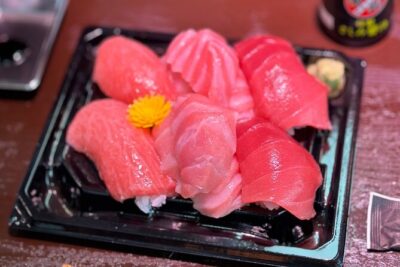

Tokyo Sushi Making Class in Tsukiji with Professional Chef
Read our review →
Tsukiji Fish Market Guided Tour and Sushi Making with Pro Chef
Read our review →Tsukiji Fish Market Food and Culture Walking Tour
Read our review →
Tsukiji Fish Market: Street Food & Culture Walking Tour
Read our review →